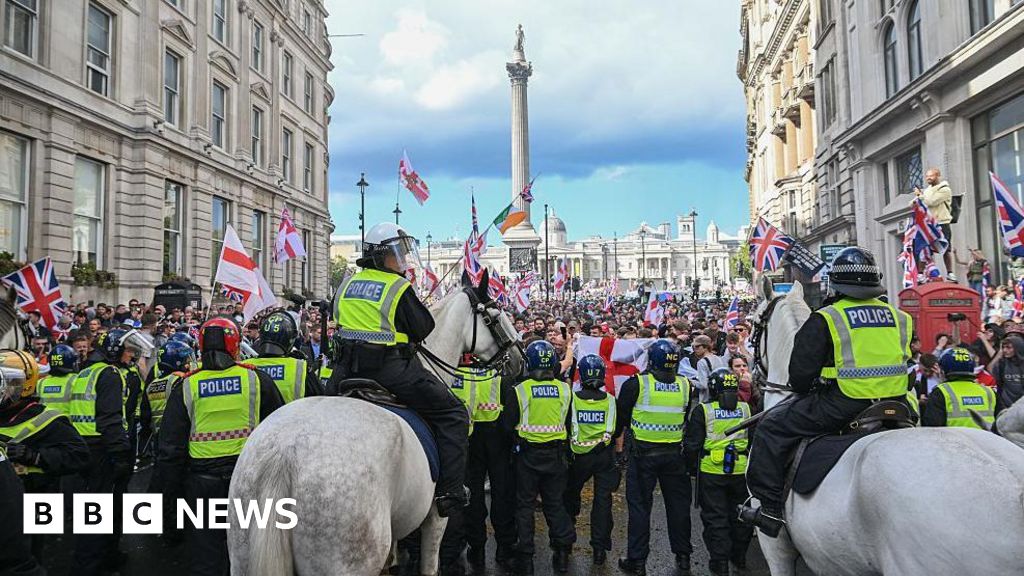
The Metropolitan Police deployed more than 4,000 officers at a reported cost of £4.5m to keep rival protests apart in central London, resulting in 43 arrests by 19:30 BST and no serious clashes. Of the arrests, 20 were linked to the Unite the Kingdom protest and 12 to the Nakba march, with 11 hate-crime-related arrests and seven additional hate-crime allegations still under investigation. The article is primarily a public-order and domestic politics story with limited direct market impact.
The immediate market signal is not the arrests themselves but the state’s demonstrated willingness to spend heavily to prevent urban disorder from spilling into critical transport and civic nodes. That is mildly supportive for UK domestic cyclicals with central-London exposure, because the base case remains containment rather than disruption: when police can successfully ring-fence flashpoints, the economic drag is short-lived and mostly confined to temporary footfall noise.
The second-order issue is escalation risk around repeat event clustering. The combination of rival demonstrations, major sporting events, and the use of new surveillance tools suggests a higher baseline for public-order spending into the next 6-12 months, which benefits security, surveillance, and crowd-control vendors more than the broad market. It also raises the probability of future legal challenges over protest policing, facial recognition, and hate-speech enforcement—creating headline risk for U.K.-listed leisure, transport, and retail names if protests become a recurring weekends-only disruption.
Contrarian take: the market may overprice “street chaos” as a macro risk and underprice institutional normalization. If police continue to contain these events without serious clashes, the political premium fades quickly, while the operational winners become more obvious. The real trade is not on London disruption; it is on the vendors and contractors that sell the tools, software, and manpower required to make sterile zones repeatable at scale.
AI-powered research, real-time alerts, and portfolio analytics for institutional investors.
Overall Sentiment
neutral
Sentiment Score
-0.05
