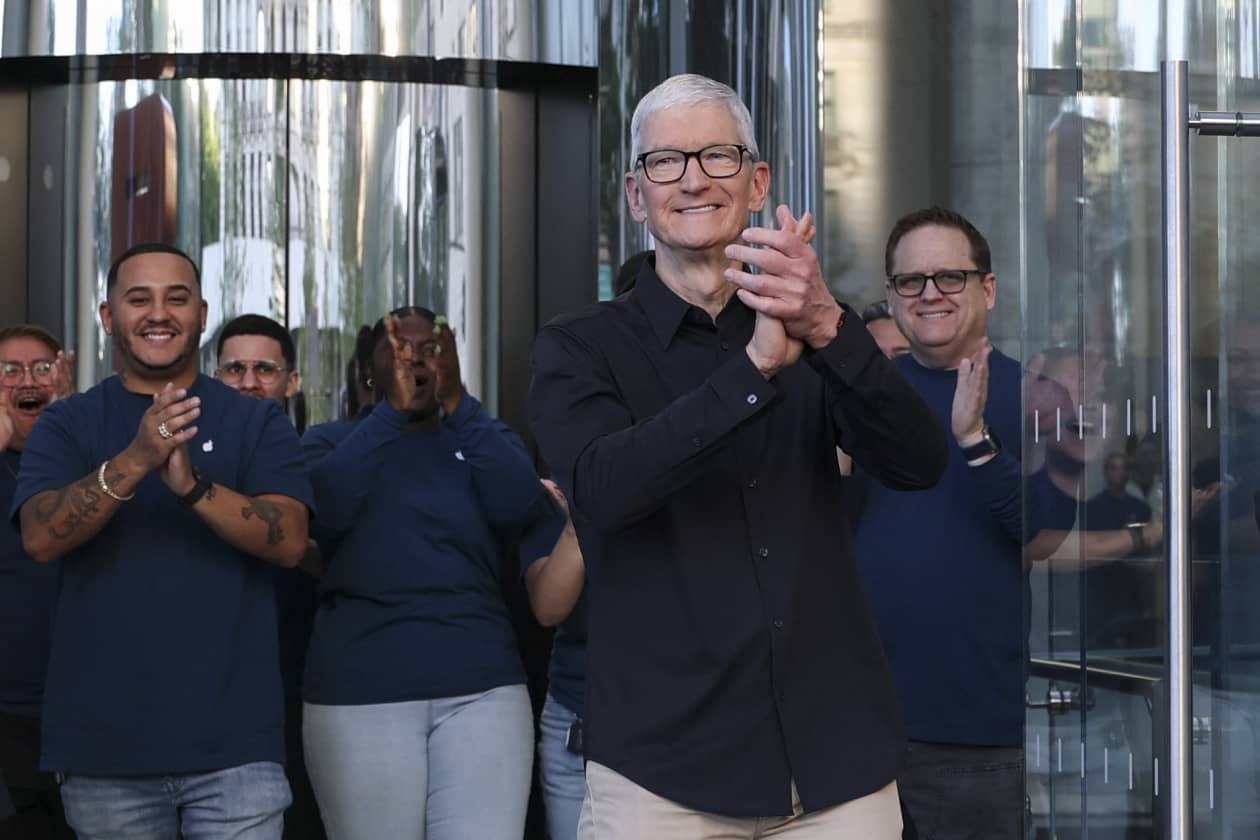
Apple announced a CEO transition effective Sept. 1, 2026: Tim Cook will step down after 15 years as CEO and John Ternus will take over, while Cook remains executive chairman. The move is significant for leadership and governance but is broadly orderly and expected, with no operational disruption cited. Cook’s tenure saw Apple reach $1 trillion, $2 trillion and $3 trillion market cap milestones and the stock rise 1,932%.
The market will probably treat this as a low-drama succession because the transition is being staged well in advance and the new CEO comes from hardware, not finance or retail ops. That matters: it reduces the odds of a sharp strategic break, but it also means the bigger medium-term question is capital allocation, not product cadence. Apple’s multiple has long been supported by a perception of operational predictability; any hint that that predictability weakens could compress the stock’s premium even if fundamentals stay intact.
The second-order winner is likely the supplier ecosystem that benefits from a less services-heavy, more product-centric posture if Ternus leans into device innovation and replacement cycles. The likely loser is the “services as a perpetual re-rating engine” narrative, because a hardware-first CEO could shift investor focus back toward unit growth, gross-margin mix, and R&D intensity. That creates a subtle risk for software/consumer internet peers that have traded partly on Apple’s ability to keep monetizing the installed base without implying slower hardware demand.
The key risk window is months, not days: the stock should be relatively insulated until investors start pricing the first budget and product roadmap decisions under the new regime. The tail risk is that a transition from a master allocator to an engineering-led operator leads to higher capex/R&D, lower buybacks, or a more experimental product roadmap that compresses margins before new growth shows up. If the incoming team signals a materially different AR/AI/wearables strategy, the move could become a catalyst for either multiple expansion or a sharp de-rating.
Consensus is likely underestimating how much of Apple’s valuation is governance-driven rather than purely fundamental. If the transition is interpreted as continuity, the headline is a nonevent; if investors start to believe the “best capital return story in large-cap tech” is ending, the downside is not the next quarter’s EPS but a multi-quarter rerating. The asymmetric setup is that the stock can drift lower on no bad earnings, simply from reduced confidence in the buyback and ecosystem compounding machine.
AI-powered research, real-time alerts, and portfolio analytics for institutional investors.
Request DemoOverall Sentiment
neutral
Sentiment Score
0.12
Ticker Sentiment
