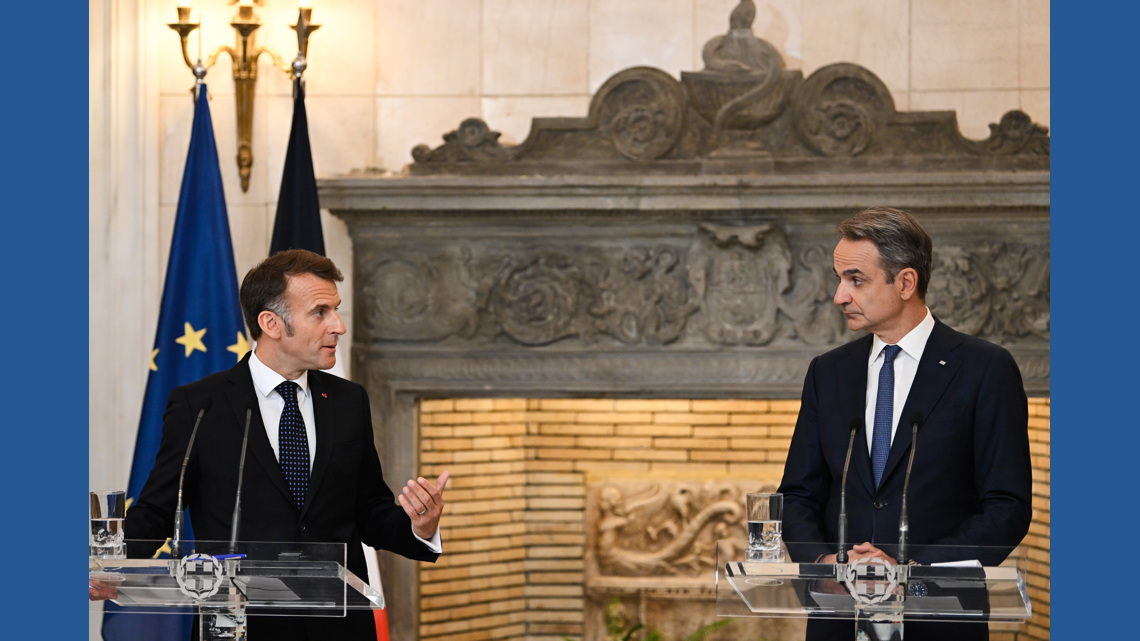
Macron and Mitsotakis reaffirmed the EU’s push to build a stronger European defense pillar inside NATO, while renewing the 2021 France-Greece defense pact that includes mutual assistance under Article 42.7. The agreement covers 24 Rafale jets and four frigates under a 3 billion euro deal, and both leaders urged greater European defense self-reliance and industrial consolidation. Macron also said fuel supply remains under control despite Strait of Hormuz risks, while Greece stressed unimpeded shipping access.
This is less about headline geopolitics than about a medium-term re-rating of European industrial policy. The important second-order effect is that defense procurement is becoming a political tool for European capital formation: if national budgets and EU institutions keep preferring local suppliers, the effective addressable market for European primes expands while U.S. defense names face slower share capture in Europe. That matters most for systems with long program duration and high switching costs, where once a platform enters the fleet, aftermarket revenue can compound for a decade or more.
The bigger winner may be the broader European manufacturing complex, not just the obvious defense contractors. A “buy European” bias, if it sticks, raises the odds of consolidation in aerospace, electronics, sensors, shipbuilding, and munitions, which should improve pricing power and utilization across subscale regional champions. The risk is that the rhetoric outruns execution: Europe still has fragmented procurement, slow permitting, and capacity constraints, so the first-order market reaction can overprice revenues that only arrive after 18-36 months.
Energy has a different setup. Even if immediate supply risk around key shipping lanes stays contained, the market is likely to keep embedding a geopolitical premium into freight, insurance, and delivered barrels, especially for Mediterranean refiners and shipping-linked insurers. The real catalyst is not a physical shortage but a repeat incident that forces a repricing of routing, bunker costs, and inventory buffers; that would hit consumer-facing transport names faster than it helps upstream producers.
The contrarian view is that investors may be underestimating how defensive self-reliance is bullish for European cyclicals and industrials, not just weapons makers. If Europe increases intra-bloc procurement and consolidation, it could lift margins for a broader basket of equipment suppliers while reducing dependence on U.S. contractors over time. Conversely, the current market may be overpaying for a persistent energy shock when the more probable outcome is elevated but manageable volatility rather than a true supply interruption.
AI-powered research, real-time alerts, and portfolio analytics for institutional investors.
Request DemoOverall Sentiment
neutral
Sentiment Score
0.05
