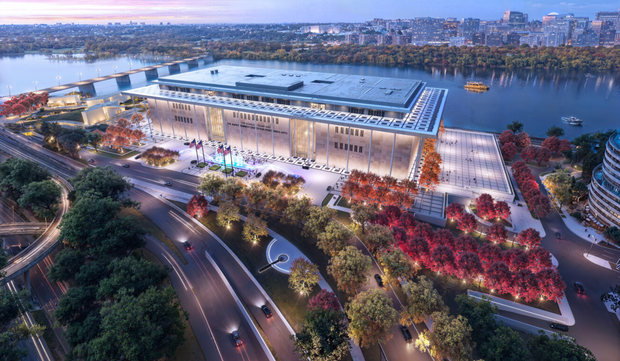
The Kennedy Center renovation is expected to cost about $200M versus $250M Congress approved, with a planned two-year closure beginning July 4 and completion targeted in 2028. Renderings released by President Trump show limited exterior changes (gold to white columns, cherry blossoms replacing willows); he said existing steel and some marble will be reused and the building will not be demolished. Trump's name was added to the facade in December without Congressional authorization, prompting criticism, and Ric Grenell will step aside with Matt Floca named CEO and executive director.
The renovation functions as a concentrated, government-facing construction program that disproportionately benefits specialty restoration trades (stone/marble conservators, historic roofing, façade carpentry, MEP upgrade contractors) rather than broad-based heavy civil contractors. Historically, programs of this profile allocate a majority of spend to specialists and systems upgrades (HVAC, acoustic retrofit, fire/life-safety) which means wins are likely for firms with existing GSA/federal historic-preservation credentials and union labor capacity rather than commodity steel suppliers.
Political and legal vectors dominate execution risk: procurement disputes, preservationist litigation, and congressional appropriation riders can pause or re-scope work for quarters to years. A single injunctive court order or targeted congressional language can convert an active spend profile into a multiyear political fight, shifting value from construction contractors to litigators, lobbyists, and contingency insurers that get paid while work stalls.
Demand displacement is the key second-order commercial effect — cancelled or rerouted programming creates a temporary captive market for alternate DC venues and touring promoters. For national platform players, the DC disruption is likely a rounding error to revenue but creates outsized upside for local venue operators, production vendors, and touring promoters that can capture rebookings at higher yield and with lower fixed overhead.
Watch catalysts on a tight timeline: bid awards and subcontract listings (near-term 0–6 months), any filed lawsuits or FOIA-driven committee hearings (0–12 months), and donor/funder guidance that presages supplemental appropriations (3–18 months). These discrete events will rotate risk premia between construction contractors, local hospitality operators, and national event platforms.
AI-powered research, real-time alerts, and portfolio analytics for institutional investors.
Request DemoOverall Sentiment
neutral
Sentiment Score
0.00
