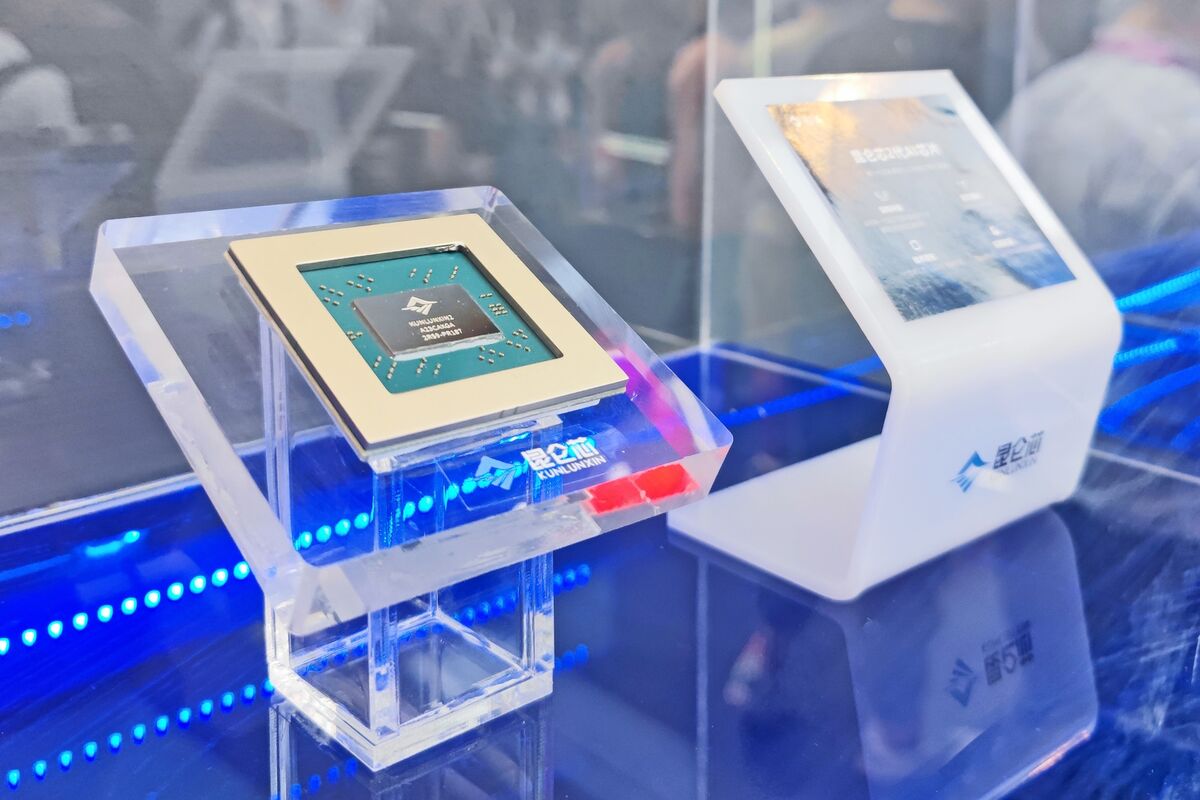
Baidu is weighing a Hong Kong initial public offering for its Kunlunxin AI chip unit, which makes chips for data-center servers and is valued at at least $3 billion, according to people familiar with the matter. Deliberations are at an early stage and details including timing and deal size remain uncertain; a successful listing would give investors direct exposure to China's domestic effort to compete with Nvidia in AI semiconductors and could attract strong local investor interest if executed.
Market structure: A Baidu-led Hong Kong IPO for Kunlunxin favors domestic AI-design winners (Kunlunxin, Baidu, SMIC/Chinese foundries, EDA/tool vendors) by signaling capital and customer appetite for China-native datacenter chips; potential losers include foreign incumbents’ pricing power in Greater China (NVIDIA exposure to China revenue) and third-party cloud margins if pricing competition intensifies. With a reported valuation floor of ~$3bn, a spin could unlock low-single-digit percentage rerating for BIDU near term and seed a domestic AI-chip pricing tier ~10–30% below equivalent western offerings, not parity yet.
Risk assessment: Near-term (days-weeks) volatility will be headline-driven around IPO chatter and prospectus leaks; short-term (3–6 months) risks are IPO pricing, tech due diligence and capital allocation; long-term (1–3 years) risks include U.S. export controls, node access (SMIC capacity constraint), and benchmark performance versus NVIDIA. Tail risks: sanctions or design/wafer failures that render the asset effectively non-commercial (low-probability, high-impact); watch capex and foreign IP dependency disclosed in the prospectus.
Trade implications: Bias to selective long exposure in BIDU (capture rerating) and domestic foundry names (SMIC) while hedging NVDA concentration. Use defined-cost option structures (6‑month call spreads) on BIDU to monetize expected vol re-acceleration around IPO milestones; size positions small (1–3% NAV) given execution and regulatory risk. Reduce overweight in pure-play GPU longs if China exposure >10% of fund risk budget and reallocate 50% of that to Chinese AI hardware/infra names.
Contrarian angles: Consensus may underprice supply-chain bottlenecks (advanced nodes) and overprice immediate competitive parity with NVIDIA; conversely it may underprice state support that can accelerate adoption. Historical parallel: HiSilicon showed design capability but fell to sanctions — outcome for Kunlunxin hinges on export-control vector and disclosed foreign dependencies; an IPO that glosses over foundry constraints is a red flag and likely to disappoint post-listing.
AI-powered research, real-time alerts, and portfolio analytics for institutional investors.
Request DemoOverall Sentiment
mildly positive
Sentiment Score
0.27
Ticker Sentiment
