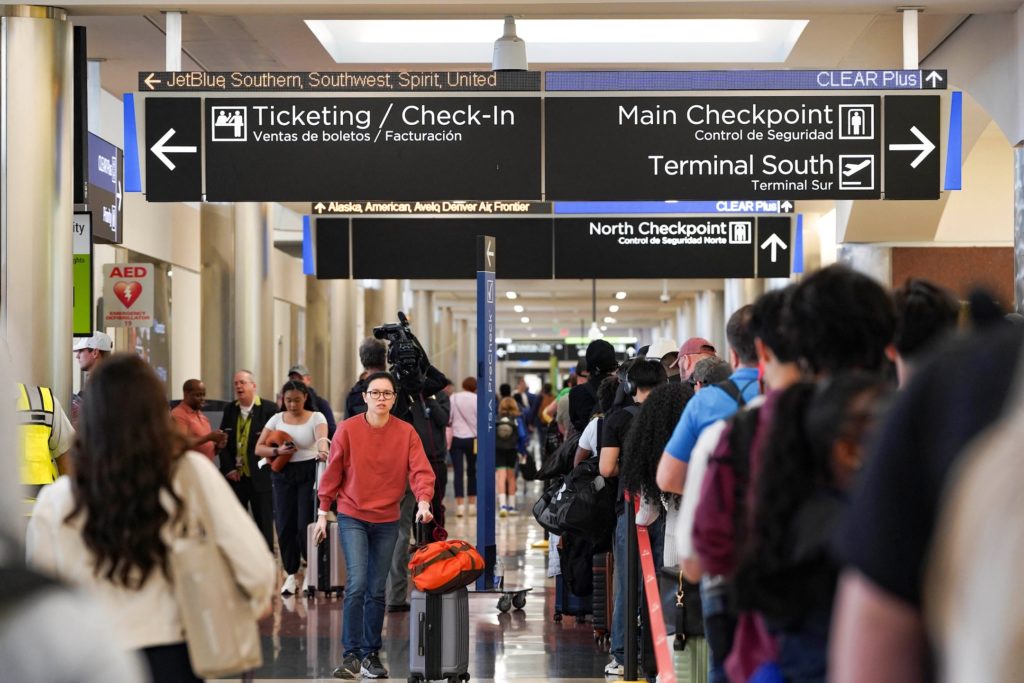
TSA workers missed at least one full paycheck amid the partial federal shutdown, causing security lines and flight delays of up to two hours or more at major airports (notably Atlanta, Houston, Philadelphia, with increasing reports at Phoenix and JFK). Workers are calling out sick, taking other jobs or quitting; airports are offering parking and meal vouchers to retain staff, and failure to resolve DHS funding before Congress' March 27 recess risks further deterioration ahead of the spring-break surge (week of March 29; ~40% of schools).
Operational fragility at checkpoint staffing is a demand shock with asymmetric cost transmission: airports and legacy carriers with hub-and-spoke networks face outsized irregular operations costs (reaccommodation, crew deadheads, IRROPS cascade) while point-to-point low-cost carriers and non-hub airports will see relatively muted disruption. That divergence will show up in short-term unit revenue volatility for network carriers and materially higher ancillary spend (hotels, car rental, meal vouchers) for stranded passengers over the next 4–8 weeks.
If the staffing shortfall persists past a single payroll cycle, expect a two-stage supply-side response: immediate ad hoc measures (airport-paid parking/meal subsidies, premium private screening) followed by structural increases in screening labor costs or contracting with private screeners. Those second-order effects raise OPEX for airports and airlines and create a multi-quarter rehiring/overtime cycle that can shave 3–6% off carrier operating margins absent fare increases.
Policy is the main swing factor: a Congressional funding fix would compress the disruption within days; a prolonged stalemate through congressional recesses creates attrition risk that is hard to reverse in 2–3 months because recruitment/training lags. That makes near-term directional trades time-sensitive — events resolve quickly if funding arrives, but attrition-driven capacity loss turns into a multi-quarter structural headwind if unresolved.
AI-powered research, real-time alerts, and portfolio analytics for institutional investors.
Overall Sentiment
mildly negative
Sentiment Score
-0.30
