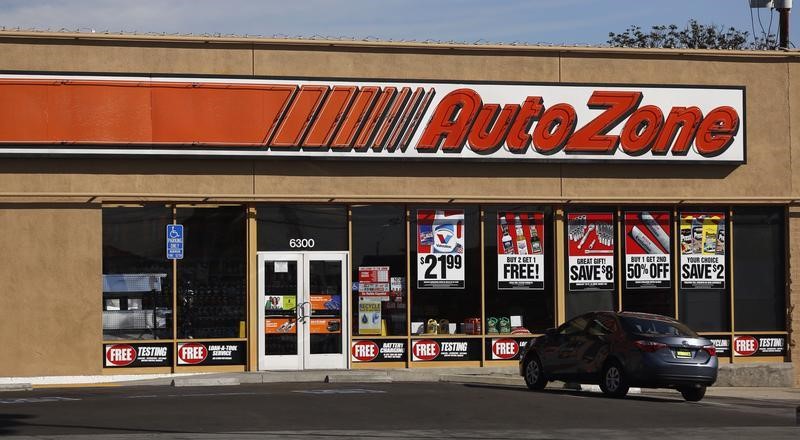
AutoZone beat adjusted EPS expectations at $38.07 versus $36.22 consensus, but revenue of $4.84 billion missed the $4.86 billion estimate, contributing to a 3.95% premarket decline. Revenue still grew 8.4% year over year, with domestic same-store sales up 4.1% and total company same-store sales up 3.9% on a constant-currency basis. Net income rose to $641.5 million, gross margin fell 57 bps to 52.2%, and the company opened 82 new stores globally, bringing the total to 7,856.
AZO’s print reinforces a subtle but important dynamic: in a slowing discretionary backdrop, the company is still taking share through service density and execution, but the market is telling you that elasticity is tightening. A modest revenue miss alongside margin resilience usually means the business is being rewarded for mix/expense discipline, yet punished when top-line momentum fails to broaden beyond repair-driven traffic. That creates a near-term asymmetry where a seemingly strong quarter can still cap multiple expansion until investors see evidence that unit growth is pulling, not just inflationary basket growth.
The more interesting second-order effect is competitive. Auto parts retail tends to be a beneficiary of an aging vehicle fleet and elevated maintenance intensity, but if consumers are trading down, the mix can shift toward lower-ticket, higher-frequency items that support traffic but not gross profit dollars. That favors the best-in-class operators with dense store networks and inventory availability, while pressuring smaller chains and local independents that cannot absorb wage and rent inflation as effectively. Supply chain-wise, the ongoing store expansion increases AZO’s leverage with vendors, which can widen the gap versus peers over the next 2-4 quarters if freight and labor remain benign.
The contrarian read is that the selloff may be overdone if investors are anchoring on the revenue miss rather than the operating margin durability. However, the key risk is not this quarter’s margin line; it is whether same-store sales can sustain mid-single-digit growth once lapping easier comparisons and if gasoline/used-car dynamics weaken repair demand over the next 1-2 quarters. If the consumer cracks, auto maintenance can prove less defensive than the market assumes, because deferred repairs eventually show up as ticket deflation before unit recovery.
For now, the setup looks better as a relative-value long than a standalone outright long: AZO is high quality, but valuation leaves limited room for error after a strong multi-year run. The cleaner trade is to favor the best operator against structurally weaker parts retail names, or to fade short-term post-earnings weakness only if same-store trends remain intact in the next monthly comp update.
AI-powered research, real-time alerts, and portfolio analytics for institutional investors.
Request DemoOverall Sentiment
mildly positive
Sentiment Score
0.18
Ticker Sentiment
