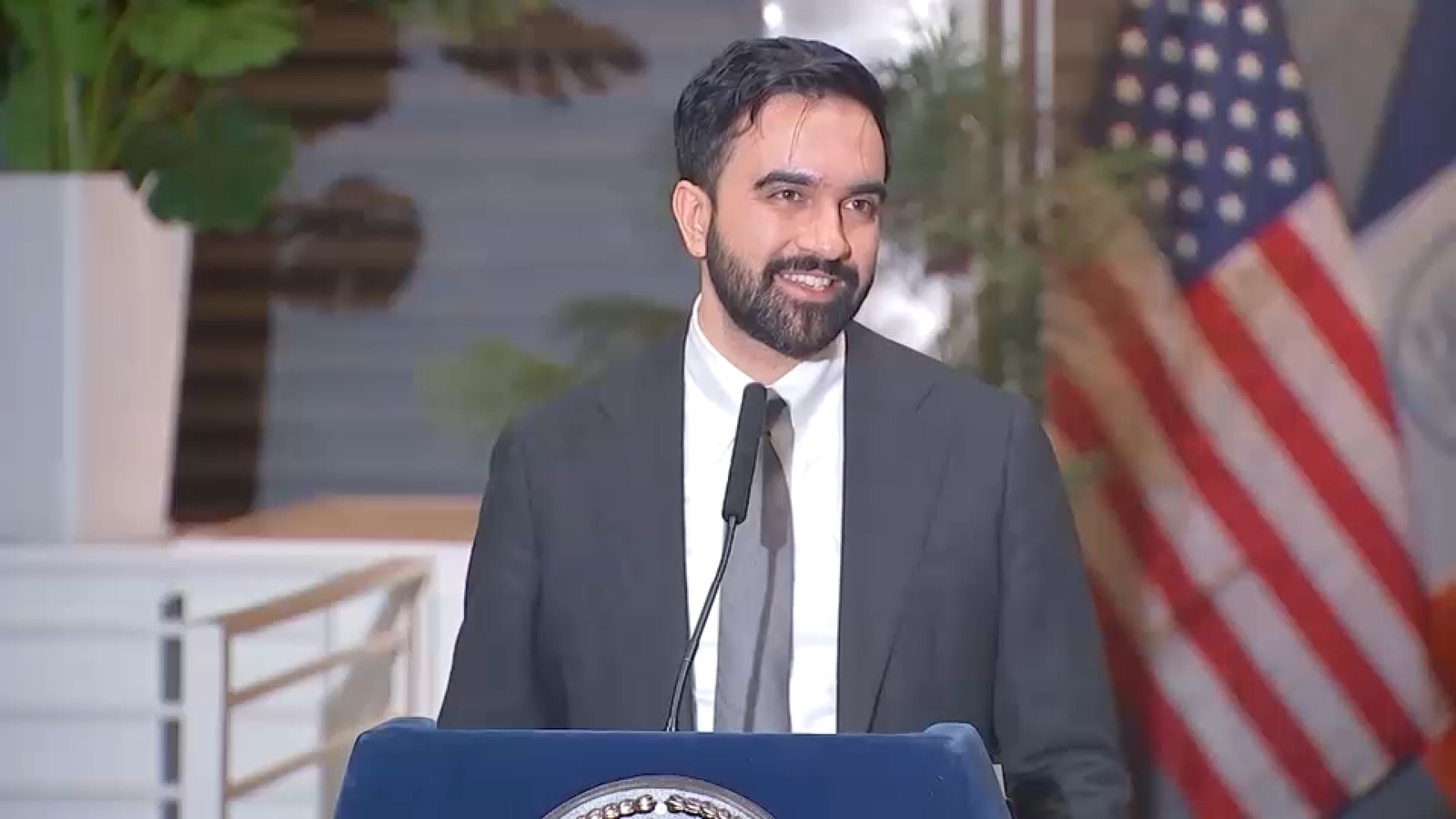
Ken Griffin said Mayor Mamdani's renewed push for a pied-à-terre tax and public criticism of his $238 million penthouse could cause him to reconsider a planned $6 billion Midtown project expected to create 15,000 permanent jobs. Griffin said the video raised security concerns and that he may increase investment in Florida, while also noting his firms paid $2.3 billion in city and state taxes and gave $650 million in charitable gifts. The dispute highlights New York tax policy risk for real estate and development sentiment, but the immediate market impact appears limited.
The market-relevant signal is not the rhetoric itself; it is the rising probability that New York policy risk becomes a tax-based hurdle rate on urban real estate and high-end development. Even a modest pied-à-terre regime or symbolic rate increase can leak into underwriting quickly because luxury condos, trophy offices, and mixed-use projects depend on a thin margin between stabilized cap rates and financing costs. That matters most for names exposed to Manhattan’s ultra-prime leasing, condo conversion economics, and private capital formation in the city, where buyers and employers can reprice location risk faster than the city can offset it with incentives.
The second-order effect is a potential relocation of marginal capital rather than a wholesale exodus. The likely losers are not just luxury owners, but also service ecosystems tied to them: architects, contractors, building services, legal/accounting boutiques, and retail spillover around high-income residential nodes. If one marquee developer signals Florida reallocations, smaller peers may quietly widen their geographic diversification, which could pressure New York job growth at the margin over 6-18 months even if headline employment remains intact.
Politically, this is a negotiation dynamic, not a settled fiscal regime. The near-term catalyst is legislative: if the tax proposal remains rhetorical, the trade fades; if it moves into budget language, the risk shifts from sentiment to cash-flow modeling and could compress valuations for NYC-linked REITs and homebuilders with concentration in the metro area. The real tail risk is a chilling effect on new project launches, because the option value of waiting rises when policy uncertainty and personal-security concerns get mixed together.
Consensus may be overestimating the direct tax hit and underestimating the signaling effect. For wealthy residents and developers, the relevant question is not the tax rate alone but whether the city is becoming less predictable and more adversarial toward capital formation. That kind of regime change tends to show up first in cap-rate expansion and project deferrals, then later in migration data and tax receipts.
AI-powered research, real-time alerts, and portfolio analytics for institutional investors.
Request DemoOverall Sentiment
mildly negative
Sentiment Score
-0.15
