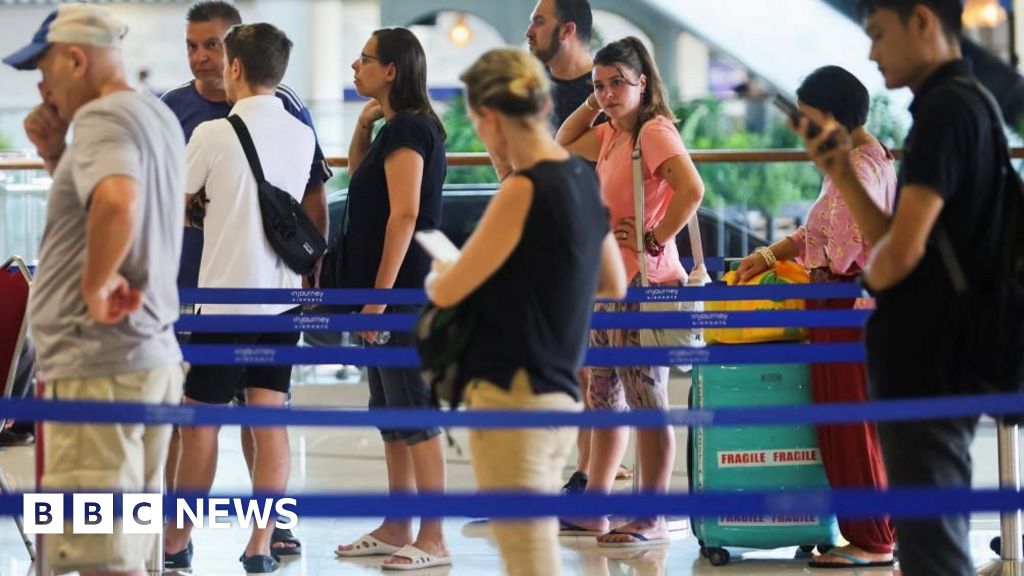
Regional strikes tied to the joint Israeli‑US action on Iran have caused massive airline disruption, with Flightradar24 reporting more than 4,000 daily cancellations across the region and Cirium reporting 79% of global flights to Qatar, 71% to the UAE, 81% to Israel and 92% to Bahrain grounded. Qatar Airways has suspended operations until Qatari airspace reopens, UK carriers have cancelled nearly all services to several Middle East destinations and hundreds of thousands of passengers are affected, producing widespread rerouting and capacity shifts that will pressure carrier revenues and create knock‑on congestion across global hubs.
Market structure: Immediate winners are defense contractors (LMT, RTX) and energy majors (XOM, CVX) from potential higher defense budgets and upward pressure on oil; losers are airlines, airport operators and travel platforms (JETS ETF, AAL, BKNG) due to cancelled capacity and lost yield on Middle East routes. Competitive dynamics favor carriers with strong domestic networks and flexible long‑haul partnerships (e.g., U.S. majors over Gulf carriers) — expect short‑term pricing power for alternative long‑haul routings and higher ancillary revenue for rerouted flights. Supply/demand: tangible supply shock to safe airspace capacity (current cancellations >70% for Qatar/UAE) compresses available seat kilometers (ASK) to the region by an estimated mid‑double digits, while fuel and insurance cost per flight rise, squeezing airline margins.
Risk assessment: Tail risks include escalation to regional oil‑infrastructure strikes sending Brent >$100/bbl for >10 trading days (high impact) or full multi‑country airspace closures >2 weeks causing sustained revenue loss and potential liquidity stress for smaller carriers. Time horizons: days — VIX and bond‑safe flows spike; weeks — airlines report operational disruption and higher unit costs; quarters — route network changes, insurance premium repricing, potential government evacuations. Hidden dependencies: cargo rerouting/logistics bottlenecks, war‑risk insurance clauses, and liquidity covenants for leveraged airlines. Catalysts to reverse: ceasefire, coordinated airspace reopenings, or rapid diplomacy.
Trade implications: Tactical ideas — establish a 2–3% portfolio long in LMT (NYSE:LMT) via a 3‑month call spread to capture defense upside if conflict persists; open a 1–2% short via JETS ETF put spread (30–60 day) to trade airline operational pain and volatility; allocate 1–2% to energy via XOM/CVX call spreads if Brent breaches $85 for 5+ trading days, with an add‑on rule at $95. Hedging: buy 0.5–1% GLD as tail insurance and consider 2% allocation to TLT or 7–10yr futures if equity risk‑off pushes 10yr yields down >25bps in 48 hours.
Contrarian angles: The market may over‑penalize large U.S. domestic‑heavy carriers (DAL, LUV) — consider a pair trade long DAL (domestic cash flow buffer) and short IAG (IAG.L) or JETS to isolate international exposure; defense upside is partially priced — prefer options to avoid overpaying for delta. Historical parallels (short airspace shocks) show recovery in 6–12 weeks once air corridors reopen; if disruptions persist beyond 6 weeks, structural network shifts will create durable winners (large integrators) and losers (small international operators). Monitor daily Flightradar cancellations and Brent; if cancellations to region stay >50% for 3 consecutive days, increase airline shorts by 50%.
AI-powered research, real-time alerts, and portfolio analytics for institutional investors.
Request TrialOverall Sentiment
moderately negative
Sentiment Score
-0.50
