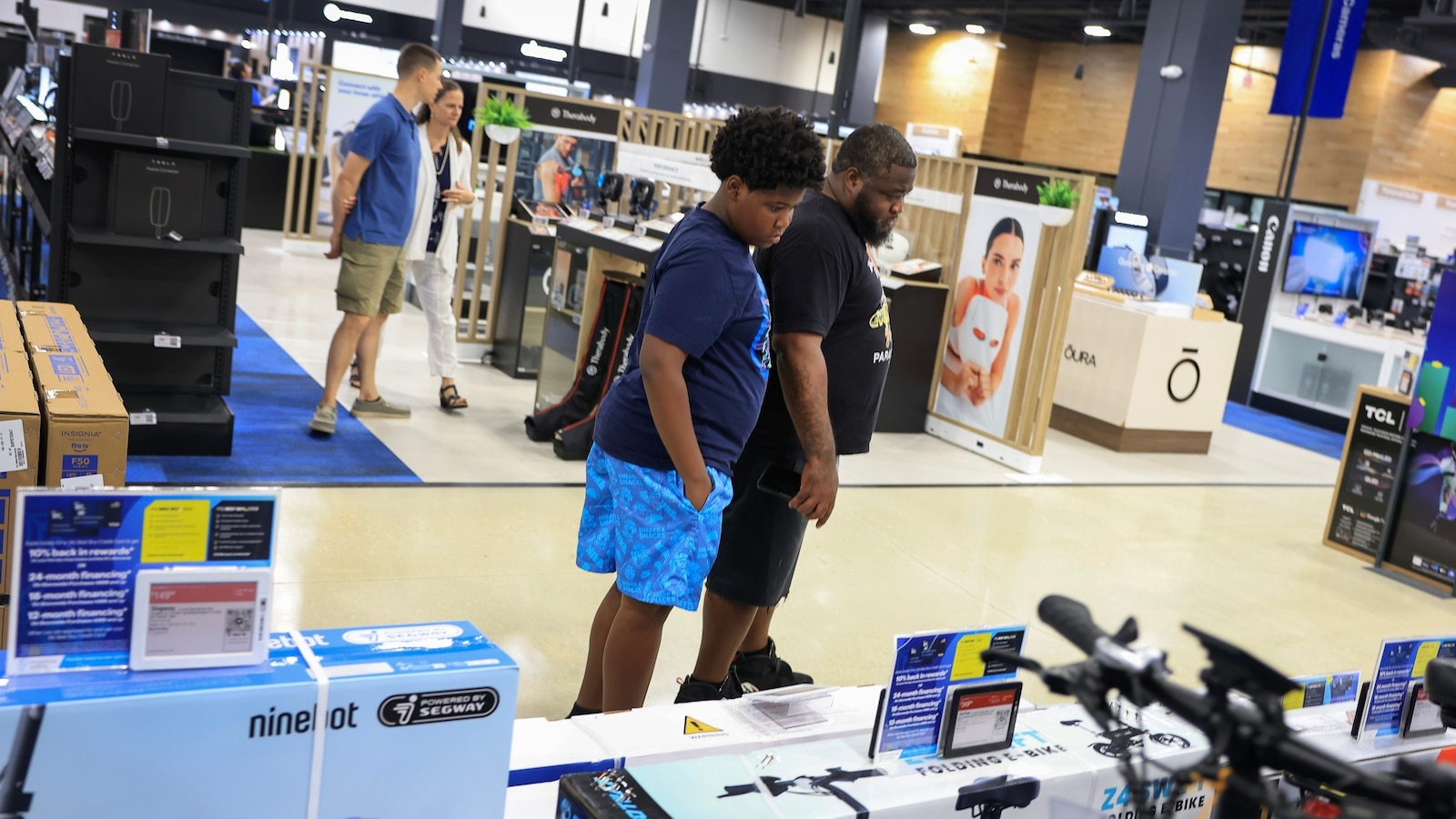
Holiday sales increased 3.9% year-over-year per Mastercard SpendingPulse, with Thanksgiving digital spending up 5% to $6.4 billion and Black Friday spending rising about 9% to $11.8 billion (Adobe). Consumers showed a clear preference for lower-cost and discounted goods — thrift and off-price apparel traffic rose 11.7% and 6.6% while luxury and department stores gained just 1.8% (Placer.ai) — and roughly half planned to use buy-now-pay-later options (PayPal). Despite slowing hiring and rising inflation, strong consumer outlays helped sustain a robust 4.3% annualized Q3 GDP print, signaling resilient but price-sensitive demand that could compress margins for higher-end retailers.
Market Structure: Holiday data (Mastercard +3.9% season, Adobe Black Friday +9%, thrift footfall +11.7%) implies demand is alive but reallocated toward low-price channels and heavy discounting. Winners: off-price retailers (TJX, ROST), payment flow owners (MA) and BNPL facilitators (PYPL) who capture volume; losers: luxury and department stores, margin-sensitive restaurants (MCD) facing footfall/mix shifts. The pricing power swing to discounters compresses industry-wide retail margins even as aggregate consumer expenditures rise.
Risk Assessment: Key tail risks are faster Fed hikes re-pricing growth (yields ↑), a spike in household delinquencies (BNPL losses), or regulatory action on BNPL/payments; each could lead to >15% downside in exposed names over 6–12 months. Near-term (days–weeks) risk centers on Q4 comps/earnings surprises; medium-term (3–6 months) on CPI/jobs data; long-term (6–18 months) on credit-cycle deterioration. Hidden dependency: Mastercard/PYPL volumes can mask mix-driven ARPU declines if discounts persist.
Trade Implications: Tactical allocations: establish 2–3% long positions in MA and PYPL (6–12 month horizon), target +15–25% upside, stop-loss 10%; add 1–2% long in ADBE as a digital-commerce analytics proxy. Open a 1% short via MCD 3-month 5% OTM puts as a hedge against casual-dining softness. Pair trade: long TJX (TJX) or ROST vs short Macy’s (M) or Kohl’s (KSS) 1–2% net to capture bifurcation.
Contrarian Angles: Consensus stresses resilience; it misses that growth concentrated in low-margin segments will create earnings dispersion—payment processors may be underpriced for stable fee-per-transaction but retailers face margin erosion. The market may be underestimating BNPL credit risk; flag a trigger: BNPL delinquency >3% or national consumer spending growth <1% q/q should prompt de-risking in PYPL and small-cap retail exposure.
AI-powered research, real-time alerts, and portfolio analytics for institutional investors.
Request DemoOverall Sentiment
mildly positive
Sentiment Score
0.30
Ticker Sentiment
