
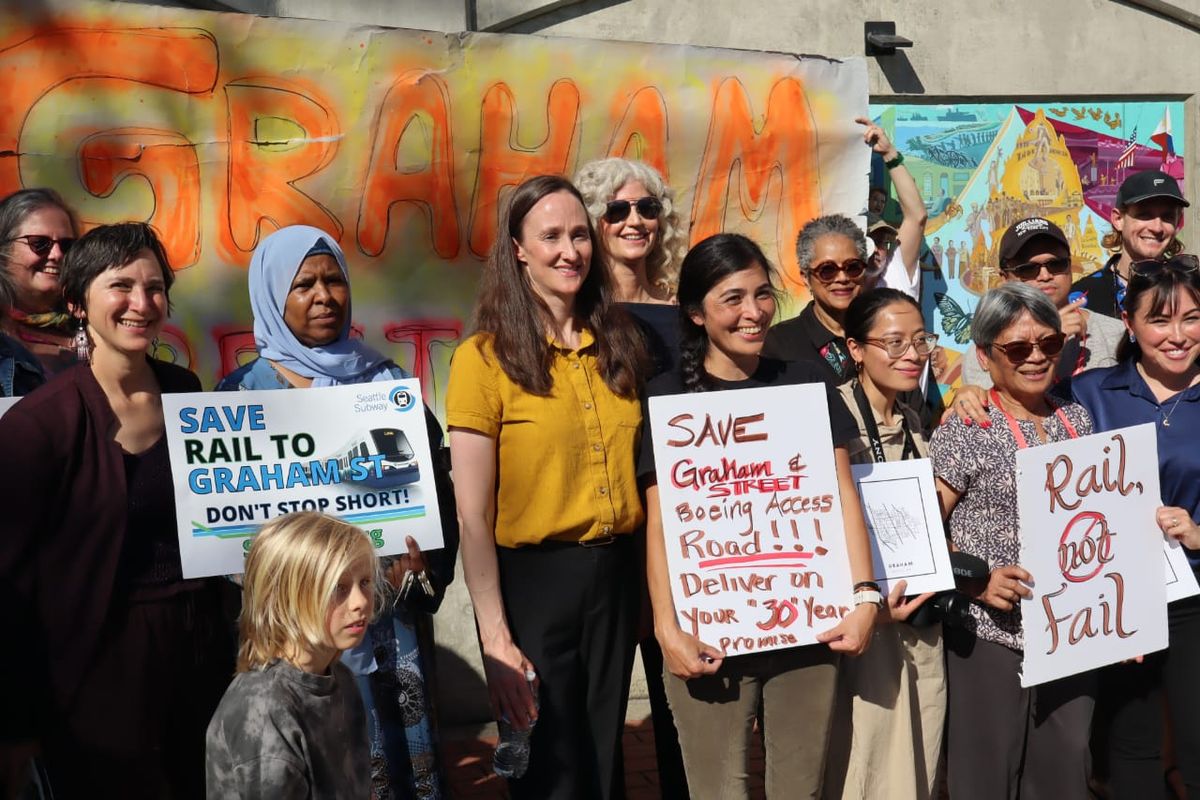
Seattle and King County announced a proposed funding package that could fully finance Sound Transit's $214 million Graham Street 1 Line infill station, using a $25 million federal grant plus up to $30 million in local contributions. The amendment is designed to keep the project near its 2031 target opening despite Sound Transit's $34.5 billion systemwide shortfall and broader ST3 delays. The article is largely local and policy-driven, with limited direct market impact.
The market read-through is less about transit headlines and more about municipal willingness to backstop capital programs when federal/state budgets tighten. If Seattle and King County are now willing to write a last-in check, it reduces execution risk for smaller infill projects with clear local constituencies, but it also exposes a broader lesson: projects with strong neighborhood politics can get funded while higher-economy projects stay stranded. That makes the near-term winner the local political coalition, not the transit agency itself.
For investors, the second-order effect is on contractors and station-adjacent real estate rather than on the single named equity in the dataset. A preserved infill station keeps optionality alive for incremental ridership, pedestrian traffic, and mixed-use density in a corridor that already absorbed construction pain; delaying it would have destroyed future monetization of sunk disruption. The bigger negative is for any firm exposed to large urban rail megaprojects where cost inflation, service-disruption contingencies, and governance churn can push deferred cash flows beyond the market’s patience.
The contrarian angle: this is not a clean bullish signal for transit capex broadly. It suggests a bifurcation where politically salient, lower-ticket projects can be rescued, while marquee megaprojects get truncated or pushed right, which may actually improve near-term budget discipline but worsen long-duration demand visibility. In other words, “saved station” headlines can coexist with a more aggressive de-risking of the overall pipeline.
BA is not directly implicated operationally; the listed ticker exposure is effectively zero. The only plausible market channel is sentiment around public infrastructure spending and federal grant dependence, which is too diffuse to trade on its own unless paired with a broader view on municipal capex execution or construction inflation.
AI-powered research, real-time alerts, and portfolio analytics for institutional investors.
Request TrialOverall Sentiment
mildly positive
Sentiment Score
0.30
Ticker Sentiment
