
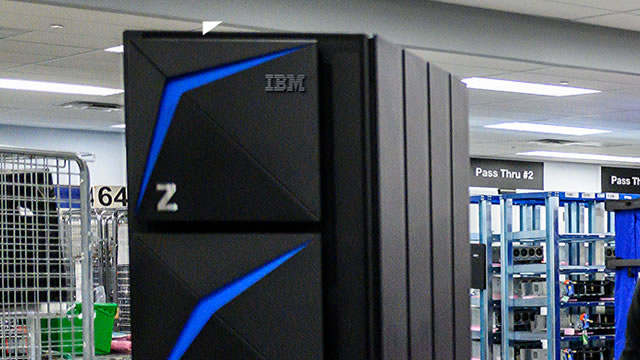
IBM reported a Q2 revenue miss of $17.2B vs. $17.86B consensus and adjusted EPS of $2.93 below expectations, indicating weaker broad demand. Segment momentum deteriorated with Software growth slowing to 5%, Consulting flat, and Infrastructure down 7%, raising concerns about sustained underperformance. The article also notes that AI infrastructure spend is flowing more to hardware/data-center suppliers than IBM, intensifying budget competition and clouding its AI growth outlook.
The key takeaway is not the miss itself; it is that the parts of the business investors had been underwriting as “AI-adjacent compounding” are not showing enough acceleration to justify a premium multiple. When enterprise budgets are tightening, spending tends to concentrate in the vendors that sit closest to the compute bottleneck and away from general-purpose services platforms, so the relative winners are the semiconductor, networking, and data-center supply-chain names that capture the capex dollar before it gets diluted by integration layers.
The second-order risk is that this becomes a budget-share story, not a one-quarter execution story. Flat consulting is especially important because services usually act as the lead indicator for software pull-through; if that pipeline weakens, the next 1-2 quarters can see slower renewal growth and less cross-sell, which pressures both revenue and the quality of bookings commentary. The market is likely to forgive modest growth, but it will not pay up for a “steady compounder” if the AI narrative keeps getting monetized elsewhere.
Over the next 1-3 months, revisions are the catalyst: any downward reset to full-year growth or margin guidance could trigger multiple compression even if absolute EPS remains stable. Over 6-18 months, the debate is whether IBM can re-accelerate above low-single-digit organic growth without sacrificing free cash flow; if not, the stock remains vulnerable to rate sensitivity and will trade more like a utility than a software compounder. The main falsifier is a clear re-acceleration in software growth and consulting bookings, ideally alongside evidence that AI workloads are becoming a meaningful revenue bridge rather than a press-release construct.
AI-powered research, real-time alerts, and portfolio analytics for institutional investors.
Overall Sentiment
moderately negative
Sentiment Score
-0.55
Ticker Sentiment
