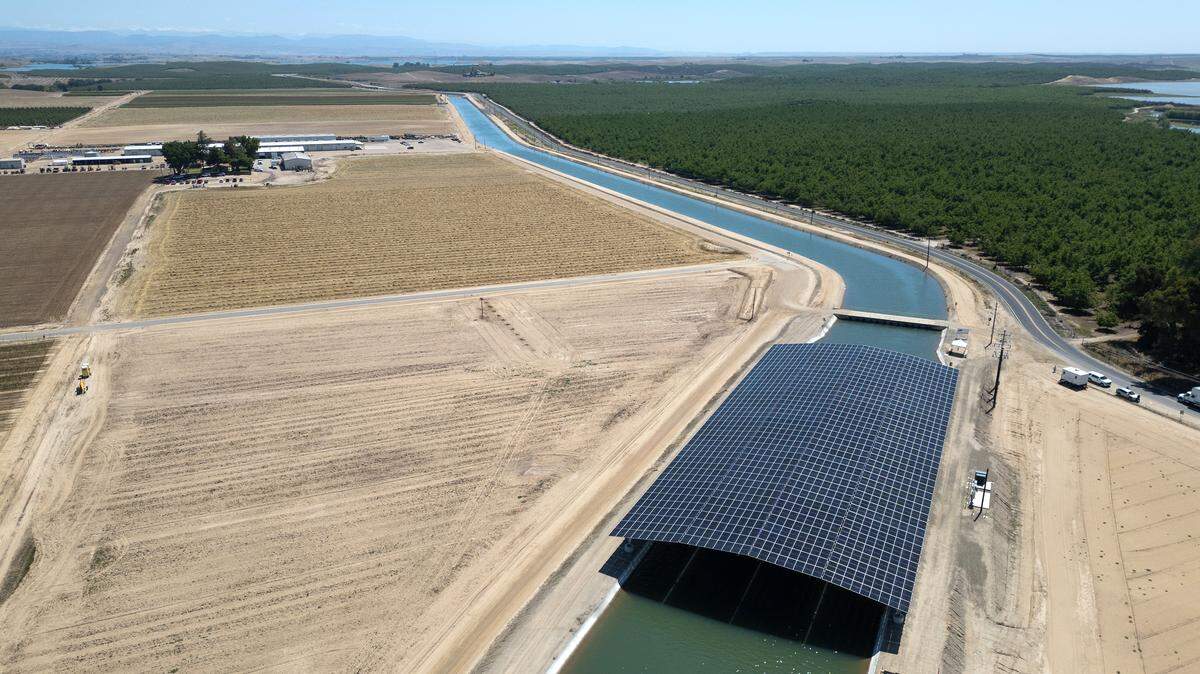
A federal grand jury indicted Carlos Ivan Mendoza Hernandez on two counts of assaulting a federal officer and one count of damaging federal property after an April 7 ICE shooting in Patterson. Separately, Modesto police arrested eight people in a shoulder-tap alcohol enforcement operation, while county inspectors flagged food-safety violations at multiple establishments. The article also highlights Turlock Irrigation District’s $20 million, state-funded Project Nexus solar-canal pilot, a notable clean-energy infrastructure initiative but not one with immediate market-moving implications.
The only directly investable signal here is not the headline itself but the policy/operational backdrop it reinforces. The solar-canal pilot is a small-dollar proof point for a broader state-level thesis: if it scales, it creates a procurement path for utility-scale solar that is less land-intensive and politically easier to permit, which is incrementally bullish for developers, EPCs, and grid hardware suppliers with California exposure. The second-order loser is land-heavy solar economics in constrained geographies, where canal-top deployment can compress the addressable market for traditional ground-mount projects over the next 12-24 months.
For BROS, the inspection issue is low severity in isolation, but it matters because the brand trades on throughput and premium convenience rather than deep moat economics. A hygiene citation rarely moves unit growth by itself; the real risk is if this becomes a pattern that nudges franchise/operator oversight costs higher or triggers local media amplification, which can shave traffic at the margin for 1-2 quarters. The stock is more vulnerable to sentiment than fundamentals here, so the downside is mainly multiple compression rather than earnings degradation.
The ICE-related legal story is more important as a volatility catalyst than as a direct equity signal. If the indictment reinforces a broader narrative around federal enforcement and civil-rights exposure, it raises tail risk for any public-company vendors tied to detention, transport, or border operations, but that link is indirect and time horizon is months, not days. The contrarian view is that these headlines often overstate durable economic impact: the solar project is a pilot, not a rollout; the food-service citation is noise unless repeated; and the enforcement case is legally specific unless it broadens into a policy shift.
AI-powered research, real-time alerts, and portfolio analytics for institutional investors.
Request DemoOverall Sentiment
neutral
Sentiment Score
0.05
Ticker Sentiment
