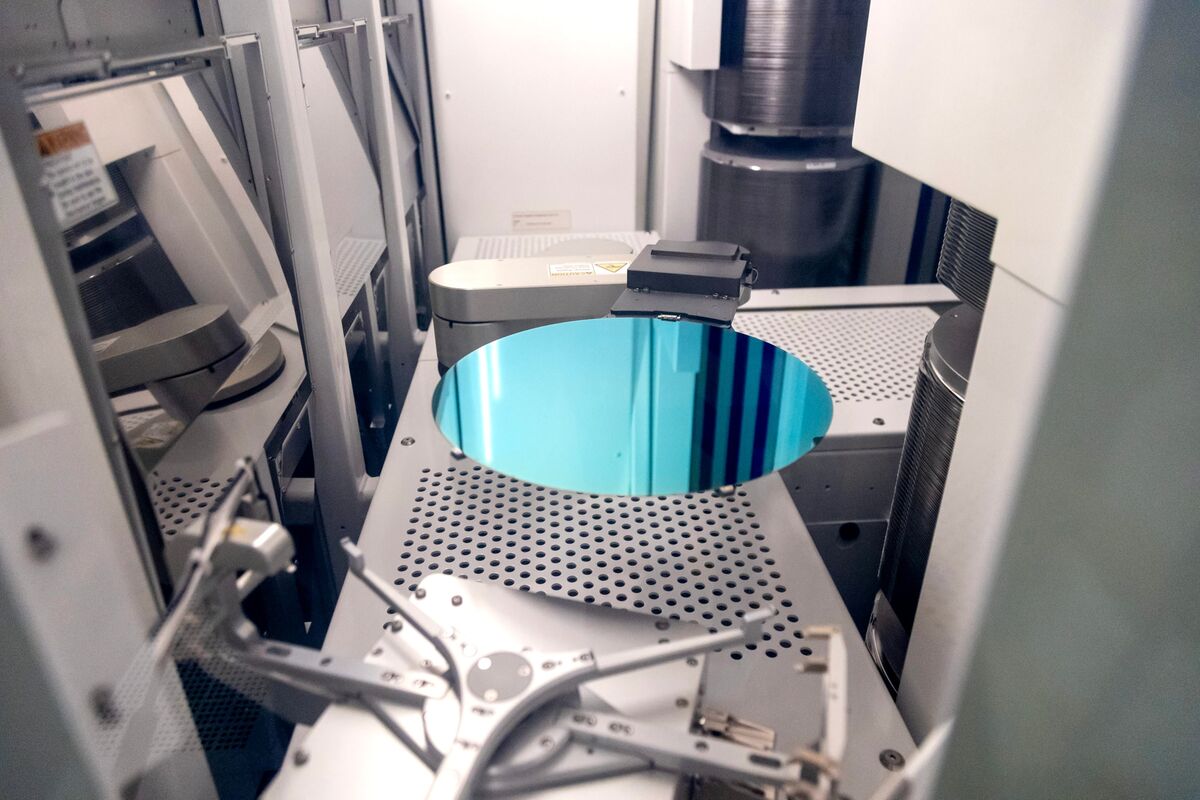
Singapore’s electronic exports jumped almost 95% year over year in May to S$7.1 billion, the biggest increase on record, driven by robust global demand for AI-related equipment. Integrated circuits were the main contributor, rising nearly 81%, while overall non-oil domestic exports increased 38%. The data signals strong momentum in the electronics and AI supply chain, though the impact is primarily macro and sector-specific rather than market-wide.
This is less a one-off Singapore data print than a read-through on the AI hardware supply chain: when a small, highly open trade hub posts an extreme acceleration in electronics exports, it usually means global assemblers are still racing to secure upstream components, not just finished systems. The second-order beneficiaries are the semiconductor capital equipment, advanced packaging, and test/inspection layers that sit above the chips themselves; those businesses tend to see order momentum before end-demand softens, so the print is supportive for the broader AI infrastructure trade over the next 1-2 quarters.
The key competitive implication is that supply remains tight enough for exporters to pass through volume growth without obvious margin compression, which suggests the cycle is still in an allocation phase rather than an inventory-clearing phase. That favors foundry-linked and component-rich ecosystems in Taiwan, Korea, and parts of Southeast Asia, while being modestly negative for lower-quality hardware assemblers that depend on spot component availability and have less pricing power.
The main risk is that this becomes a lagging indicator rather than a forward one. If a significant share of the surge reflects pre-loading ahead of trade or tariff changes, or if hyperscaler capex gets re-phased after current buildouts, the growth rate can mean-revert sharply over the next 2-3 months even if AI demand itself remains intact. In that case, the market will quickly rotate from rewarding volume beta to discriminating on balance sheet strength and exposure to higher-value nodes.
Consensus may be underestimating how concentrated the upside is: the marginal gains likely accrue to a narrow set of suppliers with AI-specific content, while broad electronics exporters may not share equally. The right contrarian stance is not to fade AI demand outright, but to avoid indiscriminate long baskets of Asia tech where the signal can tempt investors into buying low-margin, late-cycle names that will not capture the same economics if the supply chain normalizes.
AI-powered research, real-time alerts, and portfolio analytics for institutional investors.
Request DemoOverall Sentiment
moderately positive
Sentiment Score
0.68
