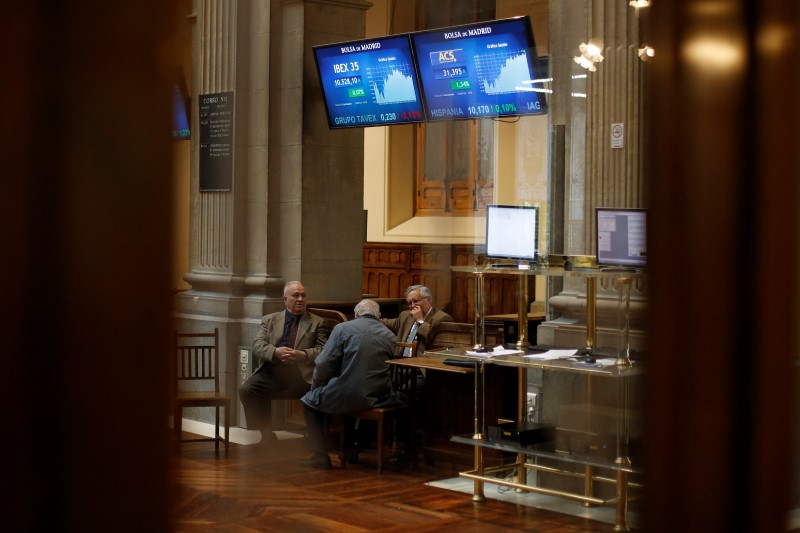
Spain's IBEX 35 fell 1.08% on Friday, with decliners outnumbering advancers 146 to 44. Indra A dropped 8.30%, Laboratorios Farmaceuticos ROVI fell 4.77%, and Solaria declined 4.35%, while Amadeus rose 0.66% and Grifols added 0.25%. Commodities were mixed, with June gold up 0.29% to $4,737.81, June crude oil down 1.95% to $93.98, and the U.S. Dollar Index Futures down 0.20% at 98.40. The article also includes promotional commentary on AI-driven stock picking, which is not market-moving news.
The cleanest read-through is not the broad index move; it is that this tape is rewarding idiosyncratic AI/semicap momentum while punishing anything with crowded positioning or near-term execution risk. That combination tends to extend for days, not weeks, because systematic flows chase relative strength while discretionary investors hesitate to fade it until the first failed breakout. In that setup, the most attractive longs are the names already showing persistent demand, while the weakest shorts are the ones with elevated beta and no fundamental catalyst to justify the move.
For SMCI and APP, the second-order effect is that “AI winner” status can keep inflows intact even if the macro backdrop is mediocre, because investors are buying narrative plus performance-chasing, not just earnings revisions. The risk is that these are now increasingly sensitive to any small disappointment in guide, margins, or product cadence; once momentum stalls, air pockets can be abrupt because positioning becomes one-way. Over a 1-3 week horizon, the best risk/reward is to own strength only via defined-risk structures rather than outright common.
GRFS looks more like a defensive relative-value opportunity than a standalone catalyst story. In a softer tape, low-volatility defensives often get sold with the market, but they usually recover faster if rates, FX, or commodity inputs stabilize; the key question is whether this is temporary de-risking or the start of a broader lower-quality selloff. If broader Europe risk appetite remains weak, GRFS can act as a parking place with less downside torque than higher-beta industrial or cyclicals.
The contrarian view is that the market may be over-penalizing single-session losers and underpricing mean reversion in names with no structural deterioration. However, if this is the beginning of a style rotation away from expensive growth into cash-flow and defensives, momentum leaders can keep working longer than expected while cyclical laggards stay trapped. The highest-conviction edge is to separate flow-driven price action from true fundamental decay and trade the former with tight risk controls.
AI-powered research, real-time alerts, and portfolio analytics for institutional investors.
Request TrialOverall Sentiment
mildly negative
Sentiment Score
-0.12
Ticker Sentiment
