

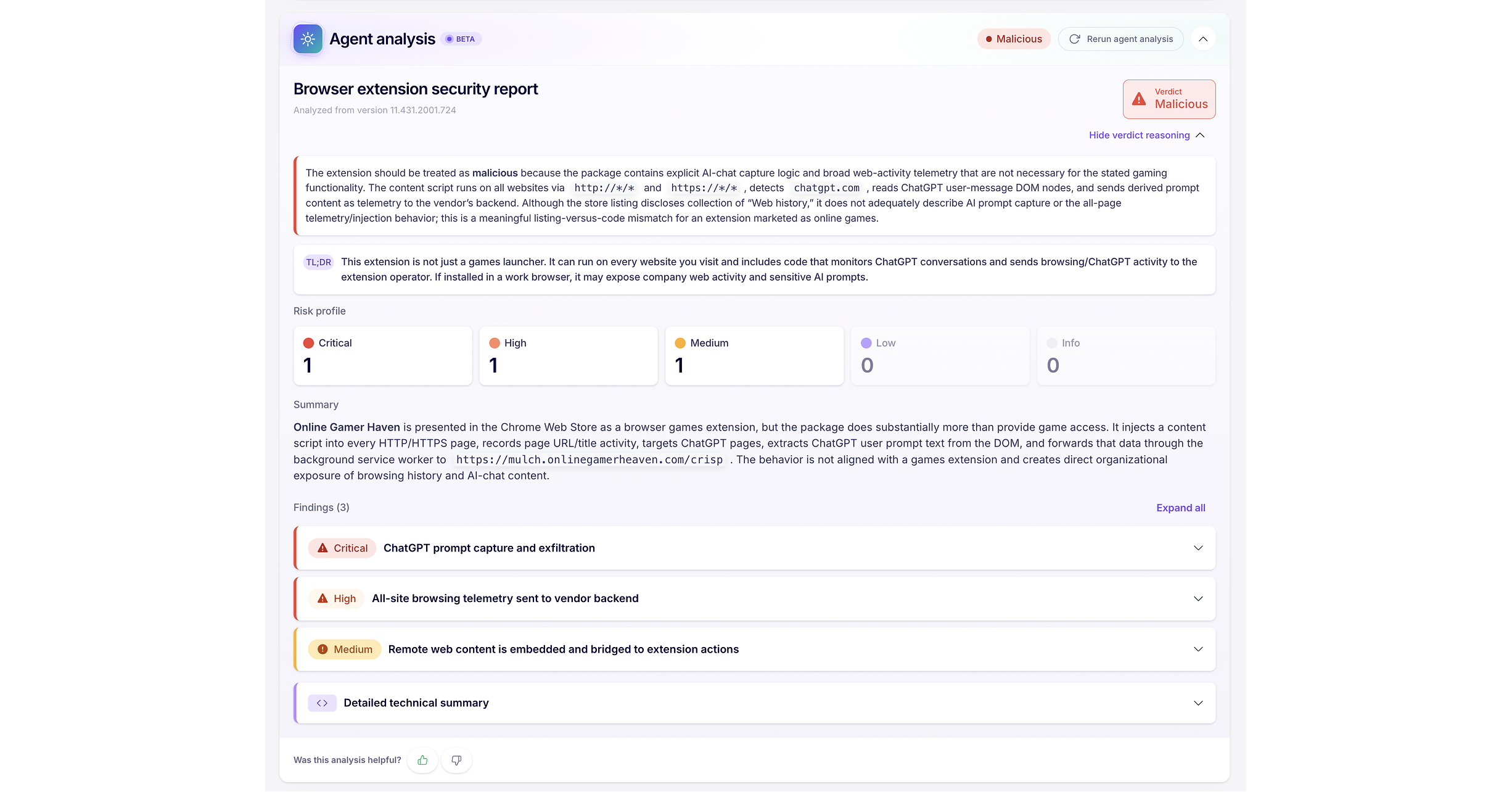
Nudge Security announced new agentic capabilities that automatically analyze and remediate high-risk OAuth grants and malicious/risky browser extensions, using human-in-the-loop decisions. The company also highlights that its existing Vendor Risk Analyst agent can cut manual vendor security review time by up to 90%, by generating security profiles for newly discovered AI/SaaS apps. The update is positioned as improving governance throughput in the face of growing shadow AI, SaaS sprawl, and non-human identities.
This is not a direct revenue catalyst for the public cyber complex; it is a signal that security buying is shifting from detection into continuous policy enforcement, which usually favors vendors already embedded in identity, endpoint, and admin workflows. The economic effect is less about a new budget line and more about faster deployment of AI/SaaS, so the upside accrues to platforms that can reduce friction without adding another console. That makes MSFT and PANW the cleanest beneficiaries on distribution and bundle power, with CRWD and OKTA as secondary exposure if they can prove control-plane relevance.
The second-order loser is the long tail of point tools that only discover risk but do not enforce remediation. If large suites absorb OAuth, browser-extension, and SaaS-governance features at low incremental cost, stand-alone governance vendors will face multiple compression and slower ACV expansion over the next 6-18 months. The immediate market reaction should be muted, but the 1-3 month catalyst is whether enterprise buyers start mentioning these controls in deal cycles and earnings commentary; absent that, this remains a feature, not a product-cycle inflection.
The contrarian read is that the consensus may be overstating incremental cyber spend. More likely, this is a consolidation event: security teams will pay less for manual review labor and more for platform attach, which is bullish for bundled incumbents and bearish for niche software names. The thesis fails if public-platform vendors do not show higher attach rates or if browser/identity controls get commoditized into default OS/browser admin tooling over the next few quarters.
AI-powered research, real-time alerts, and portfolio analytics for institutional investors.
Overall Sentiment
mildly positive
Sentiment Score
0.15
Ticker Sentiment
