





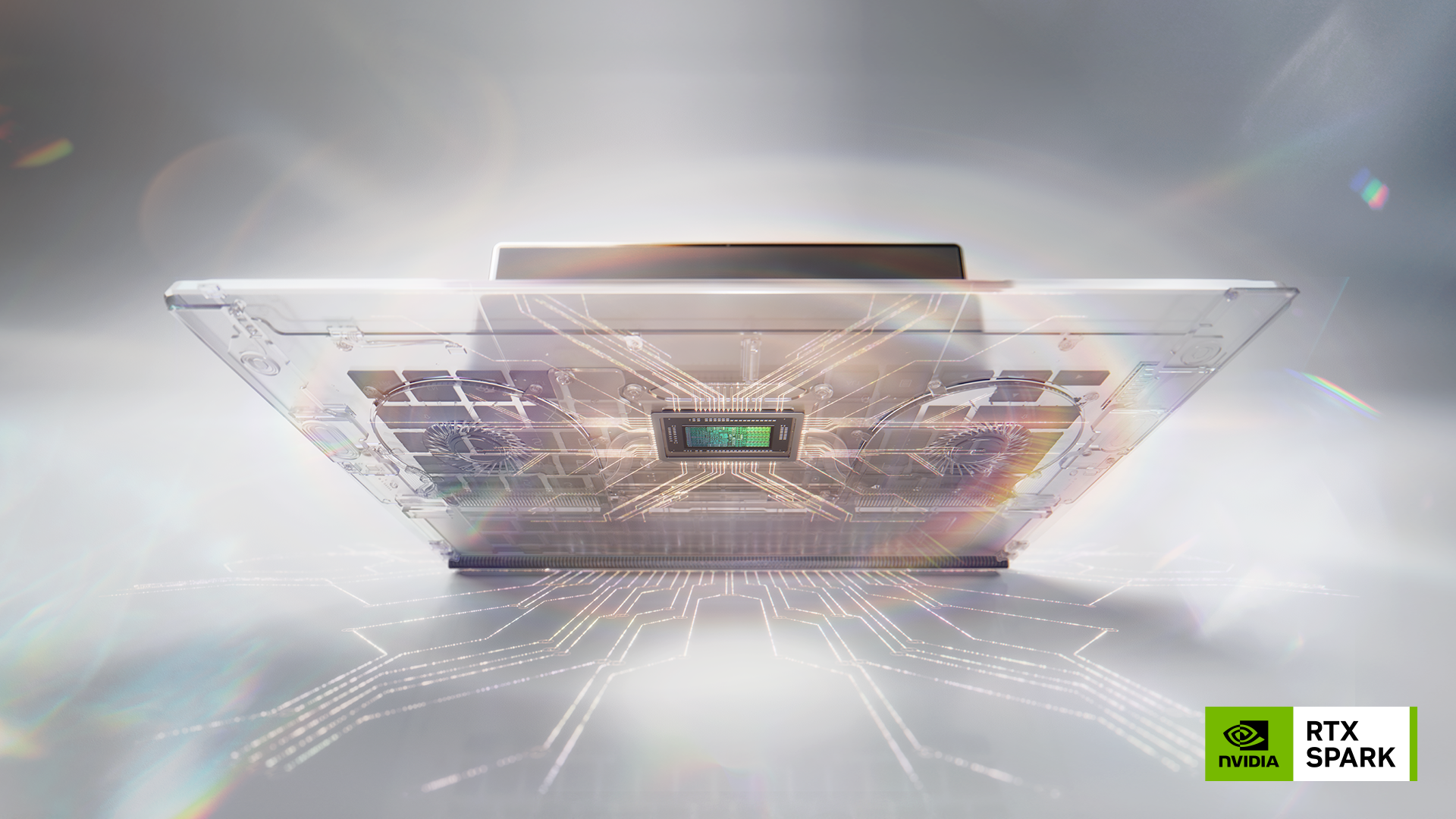
NVIDIA unveiled RTX Spark, a new Blackwell-based Windows superchip delivering up to 1 petaflop of AI performance, 128GB unified memory, and desktop/laptop designs aimed at personal AI agents. Microsoft is partnering on native Windows agent support with new security primitives and NVIDIA OpenShell, while Adobe is rearchitecting Photoshop and Premiere for the platform with up to 2x faster AI and graphics performance. The launch expands NVIDIA's AI PC push across major OEMs including ASUS, Dell, HP, Lenovo, Microsoft Surface and MSI, with availability starting this fall.
This is less a single-product launch than an attempt to create a new enterprise/software attach cycle around AI-native PCs. The strategic value is that NVIDIA is moving the performance bottleneck from cloud inference back to the endpoint, which should expand TAM for high-margin software, driver/runtime layers, and developer tooling while making Windows a stronger moat versus alternative client OS stacks. The biggest second-order winner is not just NVDA hardware share, but any vendor whose apps become ‘agent-aware’ and therefore sticky inside a new on-device workflow loop.
The near-term monetization skew is likely to show up first in premium OEM mix, then in software attach rates, and only later in broad unit volume. That means the best trade expression is not a pure PC demand bet; it is a leadership bet on ecosystems that can price in AI workflow relevance quickly, especially Adobe and Microsoft. The risk is that the capability set may outrun practical use cases: if users don’t perceive a 2-3x productivity gain, this becomes a halo product rather than a category reset, and enterprise IT will slow adoption until security/compliance standards are battle-tested over several quarters.
Competitively, this raises the bar for AMD/Intel on the high-end client roadmap because the value proposition is now unified memory + local inference + creator throughput, not CPU/GPU benchmarking in isolation. It also pressures Apple on the narrative of ‘best machine for creators’ by tying creative acceleration directly to agentic workflows and Windows app depth. On the other hand, the launch could be over-discounted if investors focus only on PC replacement cycles; the real upside is that every major software vendor will be forced to optimize for this stack, which compounds NVIDIA’s platform leverage over 12-24 months.
The main catalyst/risk line is six to nine months: initial channel sell-through and developer uptake will determine whether this is a sustained platform shift or a specialty SKU. Watch for any evidence that OEM inventory builds faster than application conversion, or that security primitives become a gating item for corporate deployment. If adoption is real, this should pull forward refresh cycles in creator and developer PCs and widen NVIDIA’s software-adjacent monetization; if not, the trade reverts to a hardware halo with limited multiple support.
AI-powered research, real-time alerts, and portfolio analytics for institutional investors.
Request TrialOverall Sentiment
strongly positive
Sentiment Score
0.87
Ticker Sentiment
