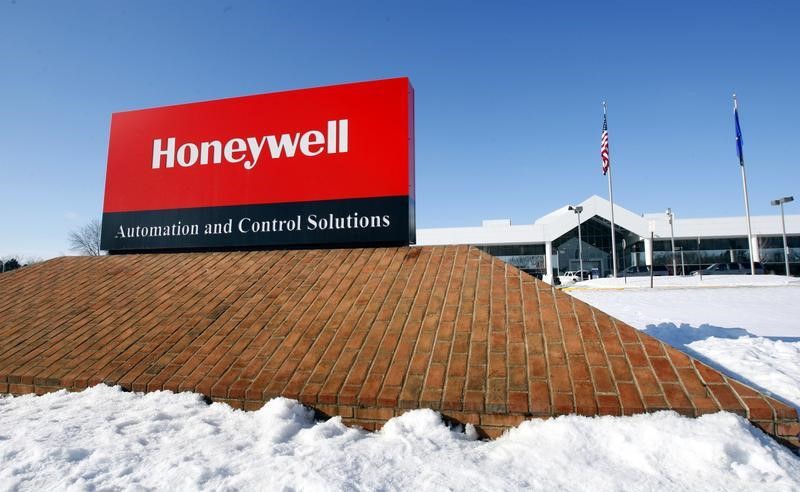
Honeywell beat Q1 adjusted EPS at $2.45 versus $2.32 consensus, but revenue of $9.14B missed the $9.28B estimate and shares fell 5.5% premarket. The company kept full-year revenue guidance at $38.8B-$39.8B and EPS guidance at $10.35-$10.65, but cut operating cash flow outlook to $4.4B-$4.7B from $4.7B-$5.0B. Management cited Middle East conflict-related disruptions, while also announcing the sale of Warehouse and Workflow Solutions and updating the Aerospace spin-off timing to June 29, 2026.
The market is treating this as a quality-of-execution miss, but the more important signal is that Honeywell is becoming a cleaner story into the Aerospace separation while still carrying a geopolitical execution tax. A backlog near record levels gives management a revenue bridge, yet the reduced operating cash flow guide implies working-capital drag is now the gating item for near-term multiple expansion, not demand. That matters because industrials typically re-rate on cash conversion more than headline EPS once growth slows into the high-single digits.
The second-order implication is mixed for peers: any supplier with exposure to the same Middle East shipping/collections friction can show similar quarter-to-quarter noise without a real demand collapse, while firms with cleaner order-to-cash cycles should look comparatively better. The spin and asset sale also create a temporary simplification premium for HON, but only if investors believe stranded-cost removal offsets the cash-flow dilution from separation timing and transaction friction. Until then, the stock can stay range-bound even with solid orders because the market will anchor on guidance credibility rather than backlog.
The move looks partly overdone on the day because the miss is more about timing than destruction of end-demand, but the downgrade to cash flow is enough to keep dip-buyers cautious. The next catalyst window is 1-2 quarters: if collections normalize and management holds revenue within guidance while converting backlog into cash, the stock can recover the post-earnings drawdown. If not, the market will start discounting the spin as a financial engineering event rather than a real catalyst, which would cap the multiple into the separation date.
AI-powered research, real-time alerts, and portfolio analytics for institutional investors.
Overall Sentiment
mixed
Sentiment Score
-0.15
Ticker Sentiment
