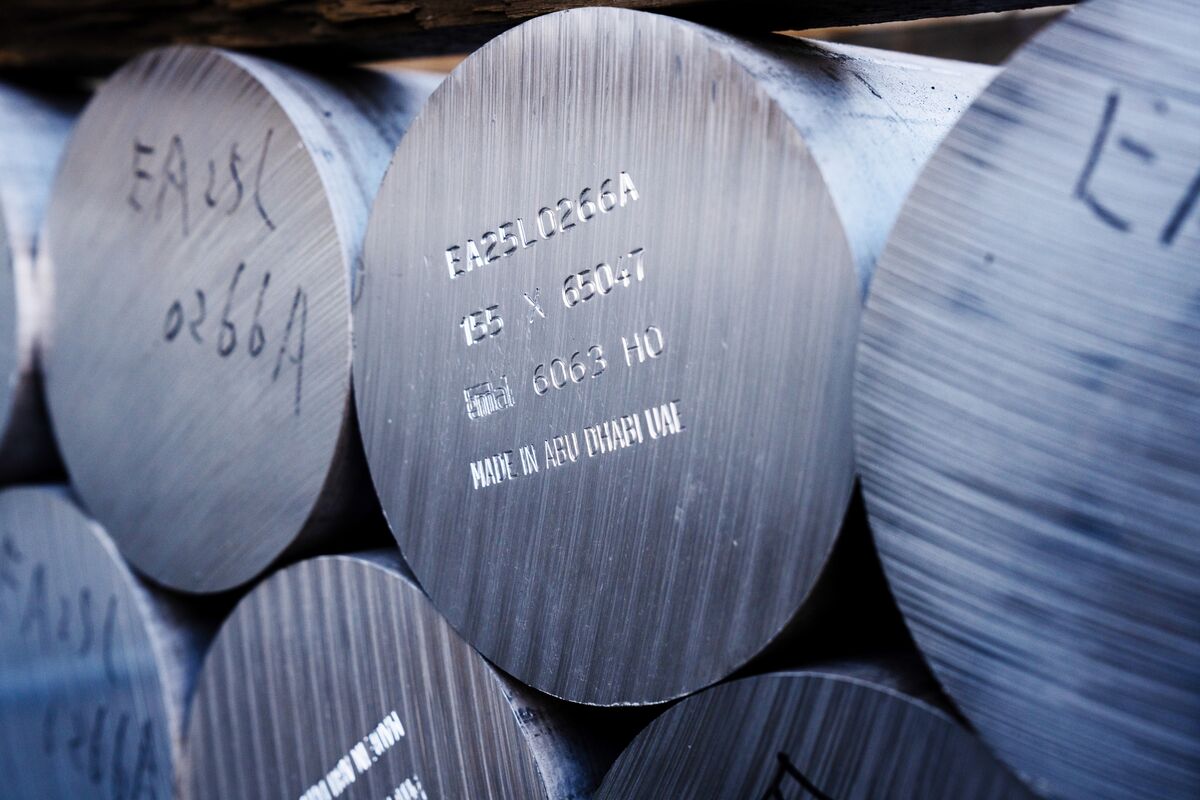
Industrial metals hit a record high on the London Metal Exchange, with the LME Index up almost 12% over the past four weeks and aluminum rising about 15% since the start of the Iran war. The move was driven by Middle East supply disruption fears and a recent revival in copper. With roughly 9% of global aluminum output coming from the Middle East, the article points to a meaningful geopolitical supply risk for the metals market.
This looks less like a clean reflation trade and more like a localized supply shock being amplified by low visible inventories and momentum chasing. Aluminum is the cleanest expression because smelting is power-intensive and geopolitically concentrated: once producers in the region pull back, the market can gap higher before end-users can re-source metal, especially if physical premiums start moving faster than futures. The second-order beneficiary is not just miners, but any upstream producer with non-Middle East exposure and low-cost hydro/power access, because buyers will pay up for certainty and shorter lead times.
The bigger risk is that the rally in the index has become self-reinforcing, which usually happens before the marginal buyer changes from industrial hedgers to speculative funds. That matters because industrial metals can mean-revert hard when Chinese restocking is complete or when freight/insurance constraints normalize; the move can reverse in days if the conflict de-escalates, but the more relevant horizon is 1-3 months for supply chains to reroute and for consumers to de-stock. If the war broadens, the market could shift from an aluminum story to a broader power-cost story, pressuring European and Asian downstream fabricators through higher conversion costs and margin compression.
The contrarian point is that the market may be underestimating substitution and demand destruction outside the headline rally. At these levels, scrap recovery, alloy substitution, and delayed capex in packaging/auto can blunt incremental upside, particularly if China’s construction demand stays soft. In other words, the upside from a fresh supply shock is immediate, but the downside from a restocking fade is more durable once buyers decide the price is insurance-expensive rather than fundamentally tight.
From a cross-asset perspective, the cleanest read-through is a relative winner/loser trade rather than outright long metals. The set-up favors producers with secure power and non-Middle East exposure, while consumers with thin margins and limited inventory buffers are the eventual losers once they begin passing through costs with a lag.
AI-powered research, real-time alerts, and portfolio analytics for institutional investors.
Request TrialOverall Sentiment
moderately positive
Sentiment Score
0.35
