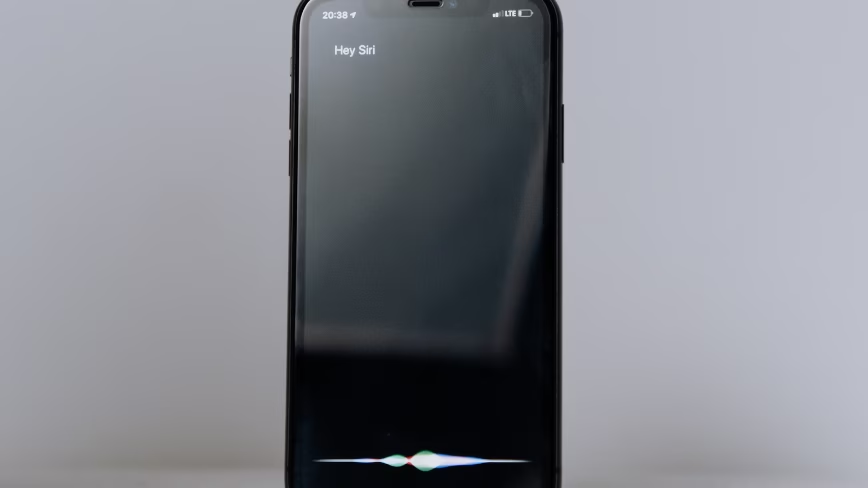
Apple’s iOS 27 beta contains an Extensions framework that could let users route Siri queries to ChatGPT, Claude, or Gemini, but the company skipped any WWDC announcement. The omission appears tied to EU regulatory friction, potential OpenAI legal action, and Apple’s desire to keep the Siri AI relaunch focused on its own model. The framework is built, but timing remains uncertain and any rollout would expand third-party AI access across more than 1.5 billion Apple devices.
Apple is quietly moving Siri from a product to a distribution layer, and that is the real inflection for AAPL. If third-party models become selectable inside the assistant, Apple’s moat shifts from owning the model to owning the user relationship, the default UI, and the billing/entitlement layer — a much stickier toll booth economics than a single AI partnership. Near term, though, the market should discount execution risk because a multi-model Siri creates complexity exactly when Apple needs a clean AI narrative to defend services premium and upgrade cycles.
The most interesting second-order winner is GOOGL, not because Gemini is the best model, but because Apple is effectively validating Gemini as infrastructure on the largest consumer device ecosystem. That creates a path to incremental distribution leverage even if the model is not branded, while also increasing the strategic cost to Apple of ever reducing Google’s role inside the stack. NVDA benefits on a slower-burn basis: if Siri becomes a multi-provider orchestration layer, inference demand rises across vendors, and Apple’s choice to anchor the experience in cloud-backed AI reinforces the idea that premium consumer AI will remain compute-intensive for longer than the market is pricing.
The hidden loser may be OpenAI, but the broader loser is any single-model “winner-take-most” narrative in consumer AI. A model-picker interface commoditizes the baseline chat layer and shifts competition toward latency, reliability, and task-specific quality — factors that are harder to build durable consumer loyalty on and easier for Apple to arbitrate. The regulatory angle also matters: EU friction and potential litigation could delay rollout by quarters, not weeks, which means the stock reaction should fade unless there is evidence of a public-facing launch plan rather than backend plumbing.
The contrarian read is that the current setup is less bearish for AAPL than the headline suggests, because the delay may actually be optimal sequencing. Apple can use 2025 to stabilize Siri quality, then introduce Extensions once user trust exists, turning what looks like a retreat into a controlled platform opening. If that happens, the real upside comes from services monetization and ecosystem lock-in, not immediate AI bragging rights.
AI-powered research, real-time alerts, and portfolio analytics for institutional investors.
Request DemoOverall Sentiment
mildly negative
Sentiment Score
-0.15
Ticker Sentiment
