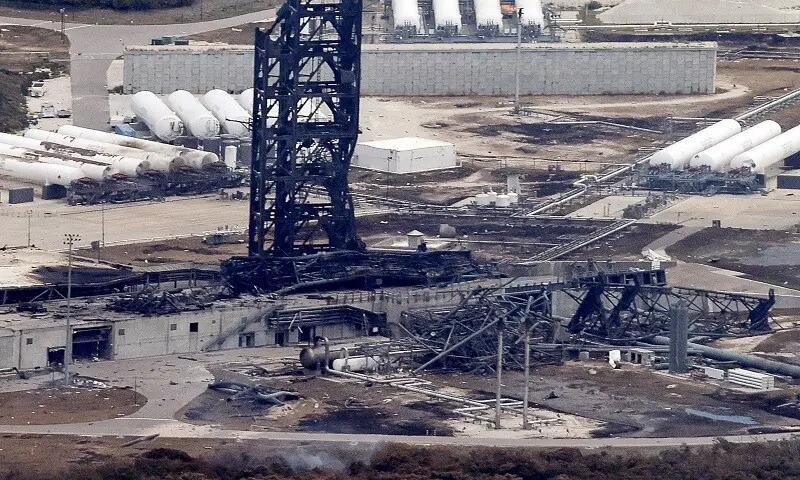
Blue Origin expects at least a six-month disruption after a New Glenn test fire explosion “practically destroyed” its launch pad, delaying rocket launches and putting Amazon Leo’s satellite deployment schedule at risk. The setback could also complicate NASA’s lunar plans and Blue Origin’s Blue Moon timetable, while strengthening SpaceX’s competitive position in commercial launch. The FAA is expected to ground the vehicle pending investigation and repairs.
The near-term beneficiary is not just SpaceX on launch share, but also any incumbent satellite operators and launch-enabling suppliers that can monetize congestion while smaller providers lose schedule certainty. For Amazon, this is a classic execution-risk reset: the market may be underestimating how much of the satellite network valuation depends on a narrow launch cadence window, where every quarter of delay compounds by pushing revenue recognition, customer onboarding, and regulatory credibility further out. The bigger second-order effect is that customers designing constellations around a “new heavy-lift entrant” now have to price in a multi-year reliability gap, which should widen the moat for proven providers and increase the value of launch insurance and dual-sourcing relationships.
The key risk is a legal/regulatory one, not just an engineering one. If the FAA investigation stretches beyond a few months, the restart date becomes an unknowable process rather than a rebuild problem, and that uncertainty can bleed into Amazon’s capital allocation and partner negotiations well before hardware is ready. In the meantime, the market may be forced to mark down the probability of Amazon meeting its deployment milestones on time, which matters because constellation economics are highly nonlinear: delays hurt network effects, spectrum utilization, and financing terms more than they hurt optics.
The contrarian angle is that this may be less of a permanent competitive setback for Amazon and more of a timing issue that helps de-risk a bad initial launch sequence. Blue Origin’s failure could actually improve the long-run business if it forces a more conservative cadence and better pad redundancy, while Amazon’s diversification reduces single-point-of-failure exposure. But the asymmetry still favors SpaceX in the next 6-12 months because it can convert operational reliability into pricing power, mission selection, and strategic leverage with customers who are now less willing to wait for alternatives.
AI-powered research, real-time alerts, and portfolio analytics for institutional investors.
Request DemoOverall Sentiment
strongly negative
Sentiment Score
-0.72
Ticker Sentiment
