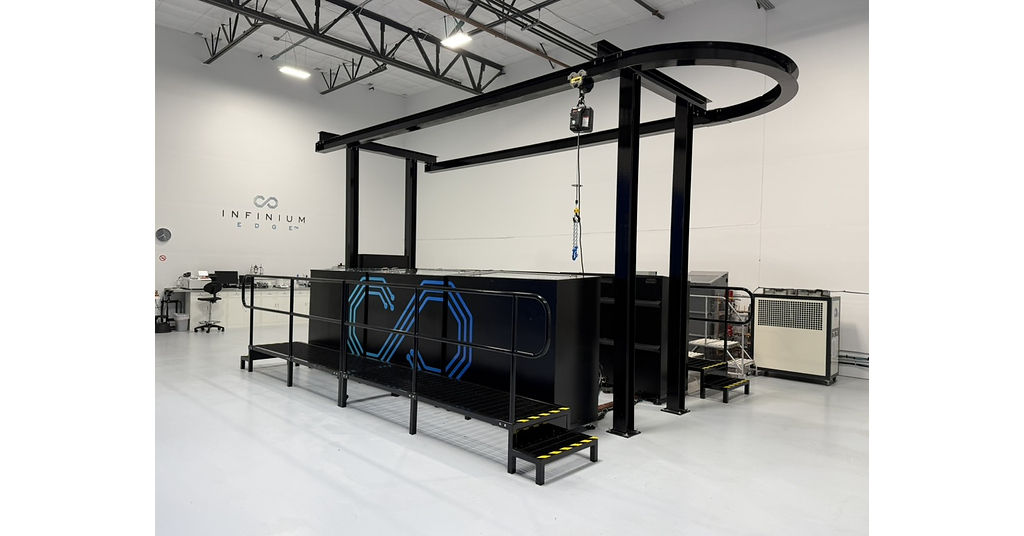
Infinium Edge launched the Infinium EdgeSites program to deploy operational AI compute in existing commercial/industrial buildings, centered on factory-built Vector ONE units delivering 1 MW of inference-ready capacity per module. The system claims up to 70% less floor space than air-cooled alternatives and no municipal water requirement via a dry-cooler loop, aiming to bypass multi-year grid interconnection queues. The article cites estimated community/regulatory delays that blocked or delayed $156B of planned U.S. data center capacity in 2025, positioning EdgeSites for faster “months vs. years” deployment for distributed inference demand.
This reads less like an immediate earnings event for the sponsor and more like an early commercialization signal for a new capex pathway: monetizing latent power capacity inside existing buildings. If the model works, the economic winner is not just the solution provider but the owners of electrical real estate—industrial landlords, warehouse REITs, and firms with underutilized switchgear—because they can convert stranded capacity into recurring rent-like revenue with limited incremental construction risk.
The more important second-order effect is competitive pressure on the traditional data-center development stack. Any workflow that compresses deployment from years to months reduces the pricing power of large-scale colocation developers and slightly shifts spend toward power electronics, thermal management, backup generation, and monitoring vendors. That said, this likely displaces only a narrow slice of high-density inference demand first; training workloads still need centralized campuses, so the near-term revenue at risk for large REITs is more about margin on scarce sites than wholesale demand destruction.
The main risk is execution, not the addressable market story. “Unused headroom” on paper often proves encumbered by transformer limits, utility tariffs, insurance, permitting, and uptime requirements once a tenant tries to run production inference on it. If the sponsor cannot show multi-site signed MW and clean site-level economics over the next 1-3 quarters, this should be treated as a marketing claim rather than a fundamental catalyst. Over 6-18 months, the structural thesis only matters if customers accept distributed inference as a durable architecture, not a stopgap.
Contrarian view: the market may be overestimating how quickly inference decentralizes. If model efficiency keeps improving, more inference can be served from existing cloud footprints, which would blunt the need for a large edge buildout. Conversely, if utility commissions start imposing standby charges or restrictions on repurposing industrial load, the supposedly cheap stranded-power opportunity can get repriced quickly.
AI-powered research, real-time alerts, and portfolio analytics for institutional investors.
Request DemoOverall Sentiment
mildly positive
Sentiment Score
0.25
Ticker Sentiment
