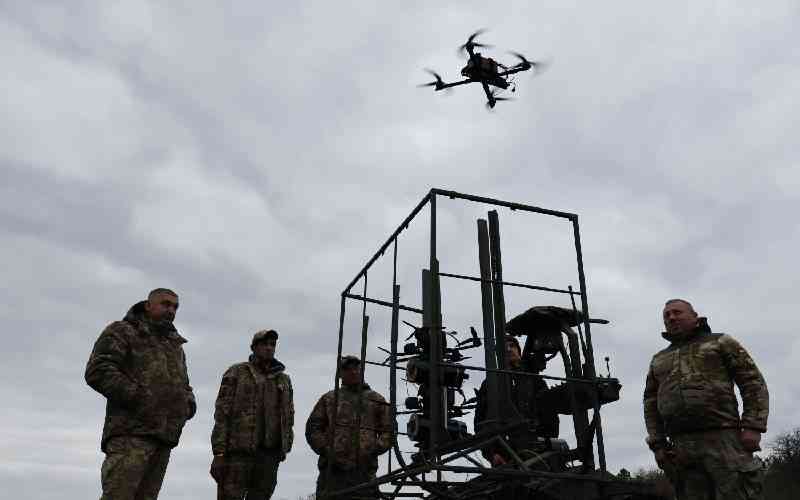
The article describes Dickson Chege’s arrival in Russia in December 2025 and his unexpected assignment to hunt Ukrainian drones on the eastern Ukraine фронт, despite having no military experience or weapons training. The piece is primarily a human-interest war narrative rather than market-moving financial news. No material company-specific, earnings, or policy data are provided.
This is more relevant as a signal about war-economy labor demand than as an isolated battlefield vignette. The second-order read-through is that Russia continues to absorb low-skill foreign labor into high-risk military-adjacent roles, implying a persistent manpower constraint and a willingness to externalize casualties and training costs. That tends to prolong the conflict rather than create a near-term de-escalation catalyst, which is supportive for defense procurement, ISR, drones, and electronic warfare suppliers over a 6-18 month horizon.
The less obvious winner is the asymmetric warfare stack: drone defense, counter-UAS, and battlefield communications. If drones remain central and Russia must improvise with minimally trained personnel, loss rates rise and the value of automation, jamming, and point-defense systems increases faster than conventional armored platforms. That shifts budget share toward software-defined defense capabilities and away from legacy heavy systems that are more vulnerable to attritional degradation.
For media/advertising, this kind of human-interest war content has low direct earnings impact but can lift engagement, subscription conversion, and habitual readership if packaged as premium-first reporting. The key risk is audience fatigue: conflict coverage can monetize well during spike periods, but sustained grim content eventually normalizes and softens conversion economics unless tied to a broader premium bundle. The catalyst to watch is any escalation in drone intensity or mobilization changes, which would re-rate the defense complex quickly; a ceasefire headline would compress that trade just as fast.
Contrarian takeaway: the market often overprices headline ceasefire probability and underprices the durability of fragmented, low-cost drone warfare. The more manpower-constrained one side becomes, the more the conflict becomes a technology competition rather than a troop-count competition, which is structurally bullish for smaller defense tech vendors and European defense primes with counter-UAS exposure.
AI-powered research, real-time alerts, and portfolio analytics for institutional investors.
Request DemoOverall Sentiment
neutral
Sentiment Score
-0.10
