

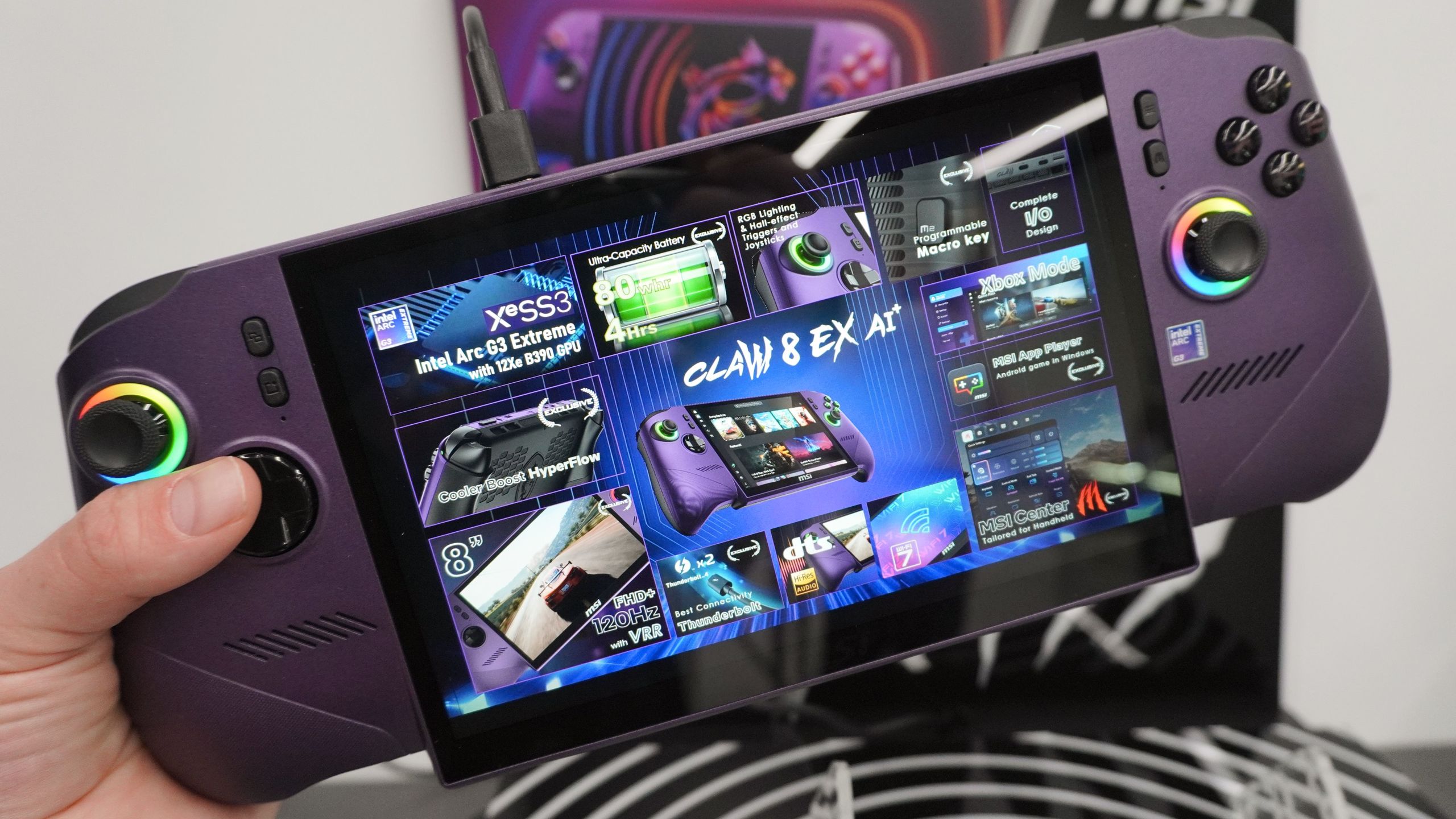
MSI’s Claw 8 EX AI+ handheld appears to be a major hardware upgrade, led by Intel Arc G3 Extreme with 12 Xe3 GPU cores, XeSS 3 support, and reported gaming results as high as 160 FPS in Hogwarts Legacy and 180 FPS in F1 25. The device also adds better cooling, improved ergonomics, and a larger 8-inch 1200p 120Hz display, while MSI is targeting a $1,500 price point. The piece is highly favorable on product performance, but the market impact should be limited until pricing and broader launch details are confirmed.
This is more than a handheld launch; it is a proof point that Intel can compete at the high end of mobile client silicon on a metric that matters commercially: frames per watt. If that holds beyond a showcase demo, the second-order effect is pressure on AMD’s handheld moat and a broader reset in buyer expectations for x86 mobile graphics, especially where upscaling and frame generation can substitute for brute-force silicon. The market will likely underappreciate how much this could influence OEM design wins in adjacent mini-PC and thin-and-light categories, not just gaming handhelds.
The bigger near-term winner is Intel’s CPU+GPU platform strategy, because the product creates a visible use case for the Panther Lake family rather than abstract benchmark marketing. That helps OEM attach rates, ASPs, and eventually ecosystem pull-through on memory, storage, cooling, and accessory suppliers. The risk is that this is still early-cycle silicon and likely constrained by supply, price, and software support; a few polished demos can translate poorly into mass-market margins if yields or memory costs stay hostile over the next 2-4 quarters.
For AMD, the threat is not just losing a headline product but ceding the narrative that its APUs are the default for portable gaming. If Intel’s solution really sustains the efficiency advantage in real usage, AMD may be forced into more aggressive pricing or faster architectural iteration, which would pressure gross margin before volume fully responds. The key contrarian read is that the market may be overestimating how quickly this becomes a broad share shift; handhelds are niche, and the adoption bottleneck is likely retail pricing, software tuning, and component availability rather than technical merit alone.
AI-powered research, real-time alerts, and portfolio analytics for institutional investors.
Request TrialOverall Sentiment
strongly positive
Sentiment Score
0.72
Ticker Sentiment
