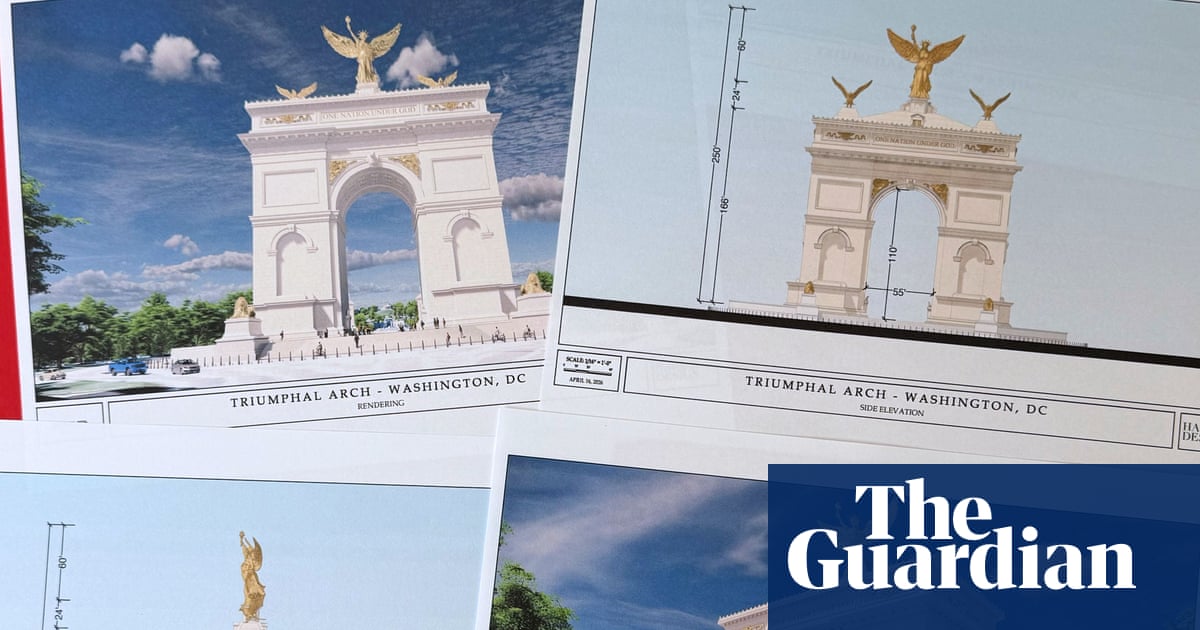
The Trump administration released new renderings for a 250ft triumphal arch, dubbed the “Arc de Trump,” to be placed at Memorial Circle near the Arlington Memorial Bridge. The project would include a 60ft golden Lady Liberty and a viewing deck, with costs still being calculated and funding expected to come from a mix of public and private sources. The proposal is pending review by the Commission of Fine Arts on 16 April and follows related White House ballroom plans that have already faced legal and construction setbacks.
This is less a construction story than a governance and procurement signal: when design approvals are politically controlled, the probability distribution shifts from normal permitting to legal delay, scope creep, and eventual cost inflation. That usually favors firms exposed to advisory, legal, and project-management revenue while hurting contractors and specialty suppliers tied to prestige public works because timelines become highly path-dependent and headline-sensitive.
The second-order effect is budgetary rather than aesthetic. Even if private money is used at the margin, any iconic federal project tends to pull in public infrastructure services, security, traffic management, and long-lead materials, creating a small but real demand tail for engineering, steel, lighting, stone, and surveillance vendors. The larger market implication is not the arch itself but the precedent: if politically aligned commissions can accelerate flagship projects while courts slow execution, capital allocation becomes more episodic and litigation-driven across DC-area federal real estate.
Catalyst timing is near-term: the April meeting is the first real check on whether the proposal is just theater or becomes a multi-month legal fight. If challenged, expect a slow-burn over weeks to months, with injunction risk and repeated redesigns producing a rolling overhang rather than a clean yes/no outcome. The key reversal would be either a court narrowing standing or the administration choosing to de-risk by scaling down scope and funding structure, which would compress the optionality embedded in the current narrative.
Contrarian view: the market may be underestimating how little direct economic value a legacy monument creates relative to the governance friction it generates. The real trade is not on the monument itself but on volatility in the federal permitting ecosystem; that favors event-driven strategies over directional construction bets. Any enthusiasm for “public-private” funding should be discounted because these structures often mask future overruns, political renegotiation, and procurement slippage.
AI-powered research, real-time alerts, and portfolio analytics for institutional investors.
Request DemoOverall Sentiment
neutral
Sentiment Score
-0.05
