

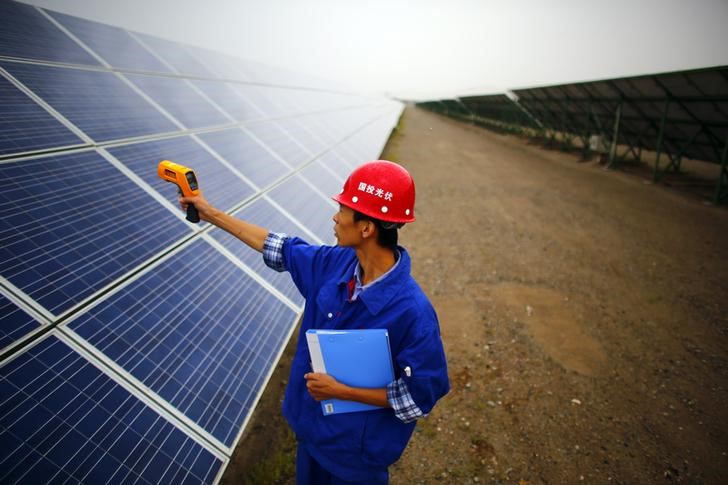
China’s clean tech exports surged in March, with solar cell shipments up 80%, EV exports up 53%, and lithium-ion battery exports up 34% year over year. EV and hybrid vehicle shipments hit a record 349,000 units, suggesting strong overseas demand as the Iran conflict and Strait of Hormuz disruption push markets toward alternative energy sources. The article is broadly positive for Chinese clean-tech and EV supply chains, while the geopolitical backdrop keeps energy markets volatile.
The market is treating the Strait event as a binary oil headline, but the deeper trade is a forced repricing of energy-input optionality. If shipping normalization takes months rather than days, marginal buyers will favor technologies with lower operating fuel sensitivity, which supports a multi-quarter demand acceleration for electrification, grid equipment, and industrial efficiency. That creates a second-order beneficiary set beyond the obvious EV names: battery supply chain, power electronics, charging infrastructure, and automation vendors that reduce fuel-linked operating costs.
The near-term winners are likely to be companies with already-built manufacturing scale and working capital capacity, because the demand shock is arriving before capacity can be fully reallocated. That favors incumbents over pure-play disruptors and implies a temporary margin tailwind for the strongest Chinese exporters, while non-China competitors may face delayed order conversion if they cannot match lead times and pricing. A weaker but important spillover is that higher overseas demand for clean tech can pressure freight, insurance, and financing terms, amplifying the advantage of suppliers with integrated logistics and state-backed capital access.
The key risk is that this is a sentiment-driven front-running move if the Strait remains open enough to let energy prices mean-revert faster than expected. If crude stabilizes over the next 2–6 weeks, the urgency premium in clean-tech procurement could unwind even if the structural trend remains intact. The contrarian view is that investors may be overestimating how much of this demand is incremental versus pulled forward from 2025 budgets; if so, you could see a strong March/April print followed by a softer summer order book.
For the named stocks, SMCI and APP are not direct geopolitical beneficiaries, but they remain levered to AI capex and risk appetite; the cleaner read is that this article improves the odds of a broader growth-factor bid, not idiosyncratic fundamental upside. If energy remains elevated, the market may keep paying up for high-duration growth with earnings visibility, but that is a valuation-support trade rather than an earnings revision story. In practice, the better expression is to own the policy- and supply-chain beneficiaries, and use the AI names only as a beta overlay if risk sentiment stays constructive.
AI-powered research, real-time alerts, and portfolio analytics for institutional investors.
Request TrialOverall Sentiment
mildly positive
Sentiment Score
0.35
Ticker Sentiment
