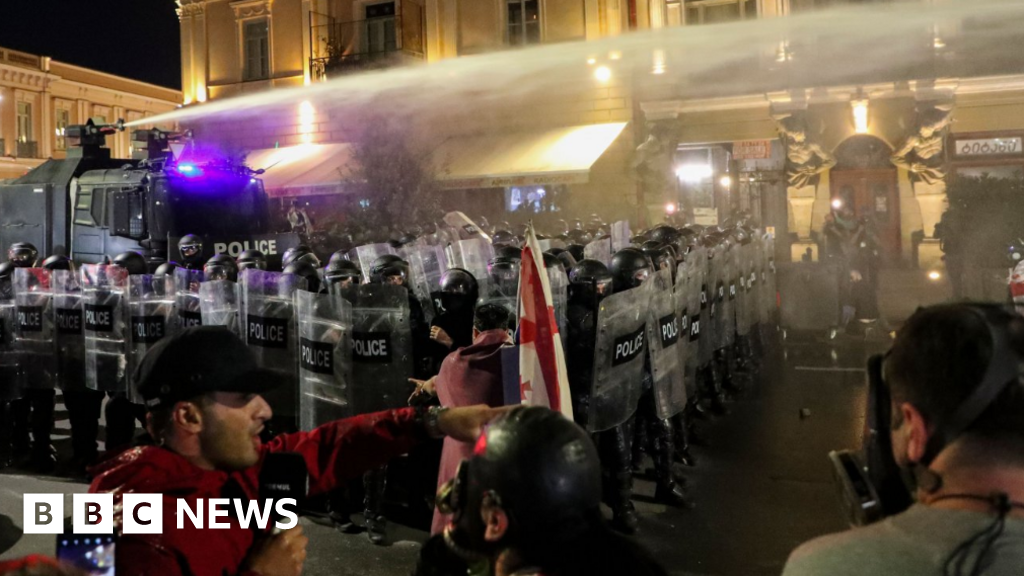
Georgia experienced escalating political instability as anti-government protesters clashed with security forces during an attempt to storm the presidential palace in Tbilisi, resulting in arrests and injuries. This unrest, coinciding with local elections largely boycotted by the opposition, stems from disputed elections last year, the ruling Georgian Dream party's pause on EU accession talks, and a perceived shift towards Russia amid a crackdown on dissent. The deepening crisis, characterized by significant political polarization and concerns over democratic governance, indicates elevated sovereign risk and uncertainty for foreign capital in the country.
Georgia protesters try to storm Tbilisi presidential palace Police in Georgia have arrested five people after clashes with anti-government protesters trying to storm the presidential palace in the capital, Tbilisi. Security forces used water cannons and pepper spray to disperse demonstrators. The Caucasus country has been in crisis since the ruling Georgian Dream party claimed victory in last year's election, which the pro-European Union opposition says was stolen. Since then the government has paused talks on joining the EU. The protest took place on the same day as local elections, which the opposition is largely boycotting following a government crackdown. Georgian Dream won majorities in every municipality, with more than 80% of the vote. Those arrested included opera singer Paata Burchuladze, one of the protest organisers. Earlier, he read out a declaration urging the employees of the ministry of internal affairs to obey the will of the people and to immediately arrest six senior figures from the Georgian Dream party. The government said 21 police officers and six protesters were taken to hospital with injuries. Waving Georgian and EU flags, tens of thousands of protesters marched in central Tbilisi on Saturday. Demonstrators then marched on the presidential palace and tried to enter the compound, prompting riot police to fire pepper spray. The demonstration follows a crackdown on activists, independent media and political opposition in recent months, with most of the leaders of the pro-Western opposition now behind bars. On Sunday, Georgia's Prime Minister Irakli Kobakhidze said that "no one will go unpunished" after what he claimed was an attempted overthrow of the government. Twenty-one-year-old Ia and her friends came to the Saturday rally prepared, dressed all in black, wearing helmets and gas masks. "If we wear something colourful it will be easier to identify us, and if they identify us we are going to jail," she said, referring to the AI surveillance cameras installed on the main Rustaveli Avenue – the focal point for the ongoing protests. Hundreds of protesters have been penalised with massive 5,000 Georgian lari ($1,835; £1,362) fines for what the authorities consider an illegal act of "blocking the streets". "I want Georgian Dream to go. I want my country back. I want to be able to live peacefully and for my friends who are in jail, illegally imprisoned, to be free." Ia sarcastically referred to the ruling party as "Russian Dream". This sentiment is shared by many of the anti-government protesters. In the regions the Georgian Dream party enjoys support with its message that it can keep the peace, while in urban centres many Georgians believe their government is acting in Russia's interests. The protest took place on the day of the municipal elections boycotted by most mainstream opposition parties, whose leaders are in jail. Events took a violent turn when a group of protesters tried to storm the presidential compound on Atoneli Street. Irakli, 24, was trying to catch his breath after escaping from that area. "There were a lot of people, and then a lot of policemen with their faces covered, all of a sudden we look behind us and see the gas released, so all these people started running, it was very chaotic and the police were running and arresting people. "Our eyes were tearing up and it was getting harder to breathe." He said there was no goal to storm the presidential palace, and blamed radicals who he said were not part of the protest movement. There have been nightly protests in Tbilisi since the government's decision last November to suspend talks on joining the EU. The protesters demand the release of political prisoners and holding snap parliamentary elections. Georgia is experiencing a significant escalation in political instability, marked by violent clashes between anti-government protesters and security forces in Tbilisi. The attempt to storm the presidential palace, resulting in arrests and injuries, underscores the depth of the crisis stemming from last year's disputed elections, which the pro-EU opposition contends were fraudulent. The ruling Georgian Dream party's subsequent decision to pause talks on joining the European Union has become a central grievance, fueling nightly protests and framing the conflict as a struggle over the nation's geopolitical orientation. Protesters' reference to the ruling party as "Russian Dream" highlights fears of a pivot away from the West. The government's hardline response, including a crackdown on opposition leaders, independent media, and the use of mass fines and AI surveillance against demonstrators, combined with the Prime Minister's vow that "no one will go unpunished," indicates a hardening political environment. This situation, reflected by a strongly negative sentiment score (-0.75) and a high market impact score (0.7), points to a material increase in sovereign risk and institutional instability, creating a highly uncertain and volatile climate for foreign capital.
AI-powered research, real-time alerts, and portfolio analytics for institutional investors.
Request DemoOverall Sentiment
strongly negative
Sentiment Score
-0.75
Ticker Sentiment
