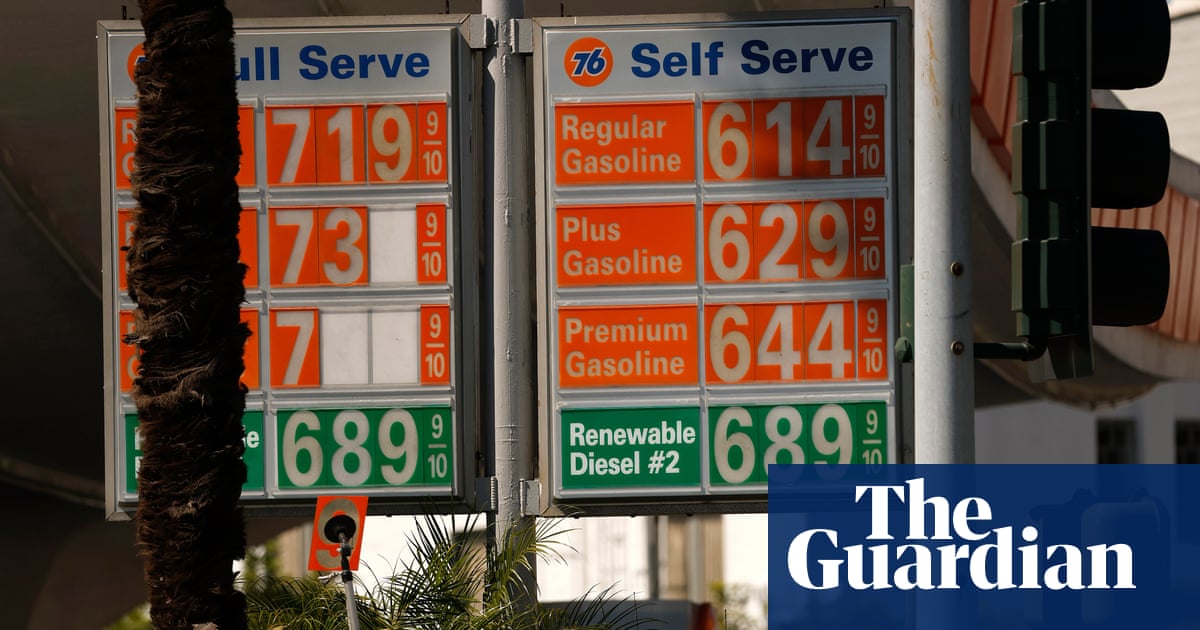
Gasoline prices have surged from below $3.00 on Feb 28 to a US average of $3.70 (+23%), with analyst Patrick De Haan forecasting $3.80–$3.85 (and diesel $5.05–$5.15). Brent spiked to $106/bbl then eased to $103, US crude briefly hit $100 before trading near $94 amid US strikes on Kharg Island and Iran blocking the Strait of Hormuz, signaling heightened supply risk. Major oil executives warned the White House of worsening disruptions and speculative upside, while US equities remained jittery (S&P ~+1% at 11am ET) as markets digest the geopolitical-driven energy shock.
A localized geopolitical shock to maritime chokepoints has become an amplifier rather than a single-directional price driver: insurance/bunker-cost inflation and shipping reroutes will create persistent regionalized basis dislocations that last longer than a headline-driven crude move. Those regional spreads matter more to refined-product markets and short-cycle US producers than to the integrated majors — refiners and storage owners capture immediate margin uplifts while heavy onshore producers can ramp or hedge within weeks.
Second-order winners are entities that own export capacity, storage and inland logistics (terminals, shorter-haul tankers, marine insurers); losers include long-haul transport, commodity-intensive manufacturing and corporates with tight diesel exposure because logistics cost pass-through lags. Integrated majors (CVX) have structural ballast from downstream and hedged volumes, which mutes upside on a short volatility horizon but exposes them to downstream margin squeeze if physical flows remain distorted.
Risk regime: expect headline-driven intraday swings (days) layered on supply-response moves (weeks) and capex/demand reshaping (quarters). Reversal catalysts are also binary and quick — coordinated SPR releases, a diplomatic de‑escalation or remobilization of insurance capacity will suck volatility out of the market within days; conversely, even brief closures or strikes at key nodes can trigger multi-week backwardation and margin shocks.
Consensus is leaning long directional crude and energy equities; the overlooked nuance is that current conditions favor directional volatility and cross‑sectional dispersion rather than broad-based major outperformance. That argues for convexity plays (options, pair trades) and sector/piecewise exposure rather than large outright long positions in integrated names.
AI-powered research, real-time alerts, and portfolio analytics for institutional investors.
Request DemoOverall Sentiment
mildly negative
Sentiment Score
-0.35
Ticker Sentiment
