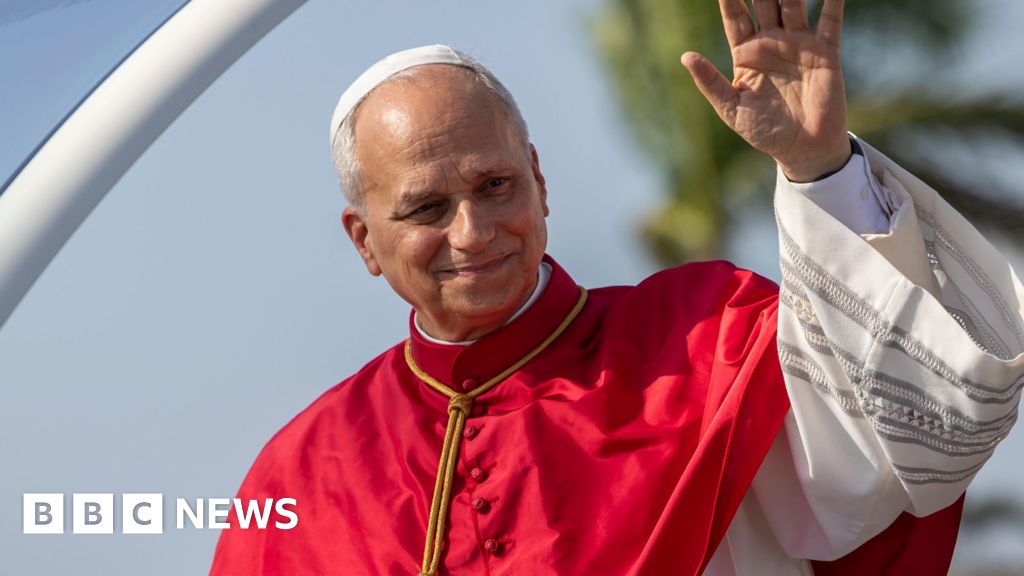
Pope Leo said his remarks about "tyrants" spending billions on war were written two weeks earlier and were not intended as a response to Donald Trump, following a public exchange with the US president. Trump had attacked the Pope as "terrible for foreign policy" and posted then removed an AI-generated image of himself as a Jesus-like figure. The article is primarily a geopolitical and political clash with limited direct market implications, though it touches on conflict in Iran and the African tour across 11 cities in four countries.
The immediate market read is not about theology; it is about how quickly a symbolic disagreement can be weaponized inside US domestic politics and then bleed into policy tone on trade, aid, and sanctions. When a global moral authority publicly challenges the legitimacy of “war spending,” it gives cover to anti-escalation voices across Europe, Africa, and parts of the US political class, which can marginally raise the probability of softer diplomatic language around conflict flashpoints over the next 1-3 months. That matters less for direct asset pricing than for sentiment-sensitive EM risk premia and defense-adjacent political narratives.
The bigger second-order effect is on reputation management in the age of AI. The fact that an AI-generated presidential image became part of the story reinforces how low-quality synthetic media can still move headlines and force real-world responses. That is structurally supportive for AI trust, provenance, and content-authentication vendors over the next 12-24 months, because institutions will pay for verification once political misuse becomes repeated and visible.
For EMs, the Africa tour adds a nuanced offset: the Church’s emphasis on a region with large, underpenetrated Catholic populations can subtly improve local soft-power flows, charity capital, and NGO attention, but not necessarily sovereign fundamentals. The more investable angle is that any incremental narrative of instability or moral criticism around war spending tends to support safe-haven FX and weigh on frontier issuance sentiment, especially where fiscal deficits are already high and security premia are fragile. This is a small catalyst today, but it can matter if it coincides with a broader risk-off tape or another geopolitical flare-up.
Consensus is likely overestimating the direct political impact and underestimating the media-amplification risk. The right framing is that this is a low-conviction, high-visibility event: by itself it should not move markets much, but it can reinforce existing positioning in defense, AI governance, and EM risk hedges if headlines keep compounding over the next few weeks.
AI-powered research, real-time alerts, and portfolio analytics for institutional investors.
Request TrialOverall Sentiment
neutral
Sentiment Score
-0.05
