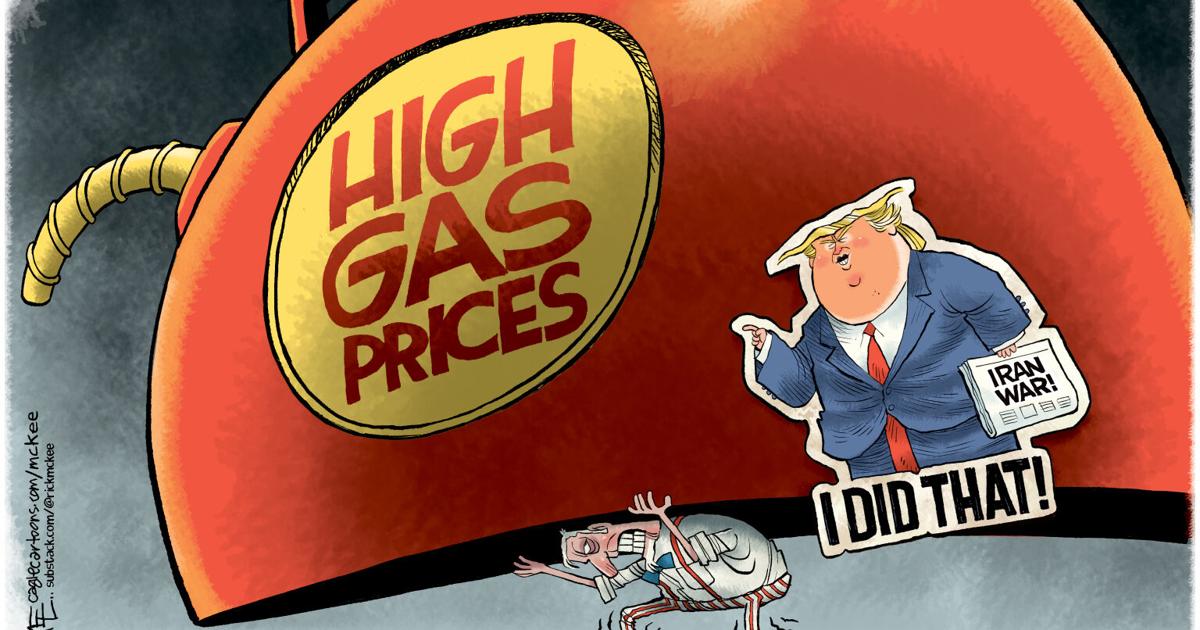
Headline: 'Trump's gas hike' (Mar 10, 2026). The article text provided contains no substantive content beyond the headline and a donation note—no figures, policy details, timing, or market implications are reported, so there is no actionable information to quantify impacts on prices or markets.
If a politically-driven, persistent increase in pump prices becomes a structural input rather than a one-off shock, the immediate economics are a blunt transfer from discretionary consumption to energy-sector cash flows. A 10% sustained rise at the pump tends to knock ~1–2% off gasoline volume within 3–6 months and adds roughly 10–20c/gal to household marginal cost — enough to shave several percentage points off leisure and non-essential retail growth over the following two quarters.
Second-order winners are those that can capture higher barrels or spreads without meaningful demand elasticity: integrated producers with global crude exposure and low leverage, select Permian-focused E&Ps with short-cycle drilling, and fuel retailers that can reprice quickly. Losers appear both directly (airlines, long-haul trucking) and indirectly (small-box retail, restaurants near highways) where fuel is a large input; freight-backlog rationalization and modal-shift (truck -> rail) could compress some logistic operators’ volumes for 3–9 months.
Key catalysts and tail risks are asymmetric on timing. Near-term reversals could come from strategic SPR releases, diplomatic deals reintroducing sanctioned barrels, or a rapid fall in refined product cracks if demand softens; those would bite energy longs inside 30–90 days. Conversely, if the policy endures into an election cycle, expect persistent inflationary signaling, higher breakevens over 3–12 months, and a regime where consumer staples and energy trade like bond proxies while discretionary multiples compress.
AI-powered research, real-time alerts, and portfolio analytics for institutional investors.
Request DemoOverall Sentiment
neutral
Sentiment Score
0.00
