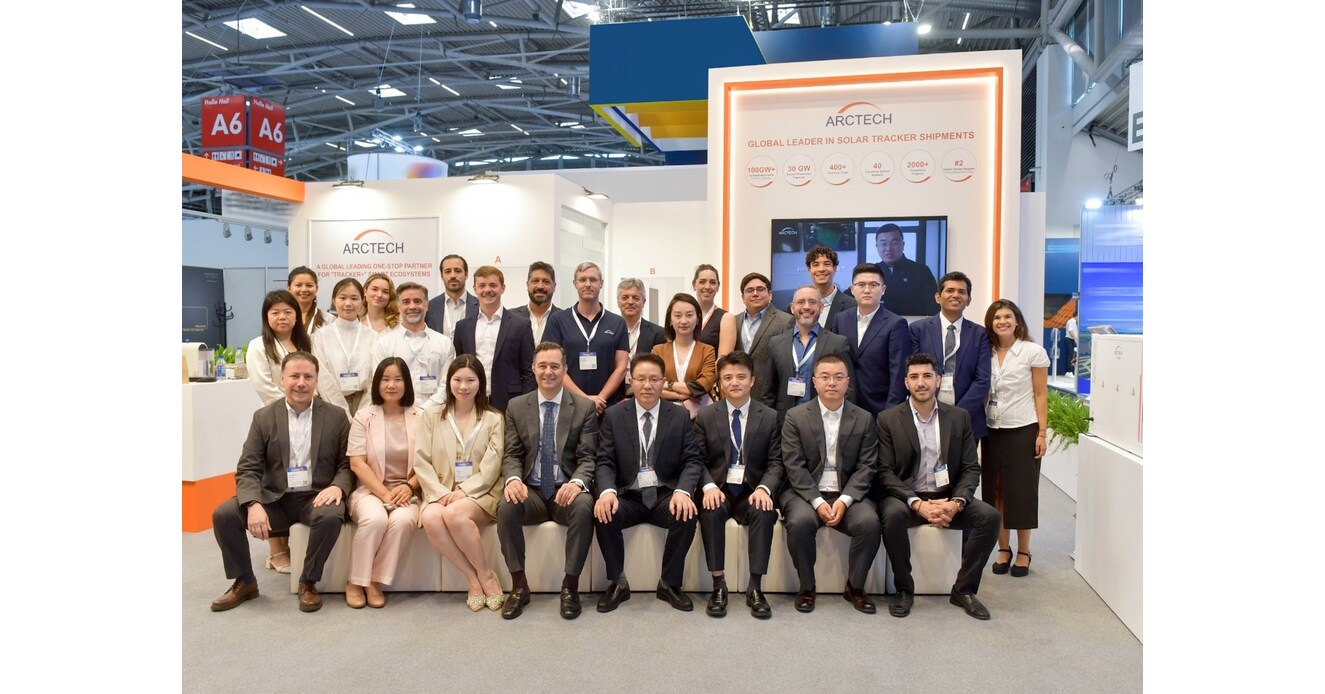
Arctech showcased its “Tracker+” solar tracking ecosystem at Intersolar Europe 2026, positioning its AI-enabled trackers and autonomous cleaning (Star Shine) for complex European sites (mountains, high wind/snow). The company highlighted European deployments totaling 342MW (Romania), 266MW (Greece), and 52MW (Poland), and announced new signed projects totaling 132MW in Turkey and Zambia. Overall messaging is supportive of continued growth in utility-scale and agrivoltaics, with limited direct financial impact implied by the release.
This reads more like competitive positioning than a standalone market event. The real signal is that European utility-scale solar is shifting toward harder-to-build sites, which increases the value of trackers with wind-load engineering, terrain tolerance, and O&M add-ons; that tends to favor vendors with higher software/service content and a local installed base. The risk is that this also commoditizes basic tracker hardware faster in Europe, forcing ASP pressure on the lowest-cost suppliers while shifting profit pools toward warranty, monitoring, and cleaning services.
For public comps, NXT is better insulated than ARRY if the market is rewarding reliability and bankability over pure price, while smaller or more leveraged names are more exposed to European bid discipline. The second-order effect is on EPCs and project developers: more complex sites raise total installed cost, so only the best-capitalized developers should keep IRRs intact; weaker names may defer projects or accept lower margins. If this complexity trend persists, it is mildly supportive for higher-efficiency module suppliers and agrivoltaic enablers, but only over 6-18 months.
Contrarian view: this may be more promotional than economically material until backlog converts and margins hold. The consensus may be underestimating how quickly Chinese tracker competition compresses pricing in Europe; if Arctech is winning share, that is a read-through that incremental growth is becoming more competitive, not necessarily more profitable. The key falsifier is whether NXT/ARRY can still print stable EMEA bookings and gross margin in the next 1-2 quarters despite this backdrop.
Near term, expect little direct price impact outside of sentiment in solar hardware. The actionable catalyst is earnings commentary: order intake, backlog mix, and whether service/solutions revenue is offsetting tracker ASP deflation. If those metrics weaken, the winner is not the solar hardware sector but the buyers of cheaper capacity; if they improve, this supports a rerating of the premium tracker complex.
AI-powered research, real-time alerts, and portfolio analytics for institutional investors.
Request DemoOverall Sentiment
mildly positive
Sentiment Score
0.25
