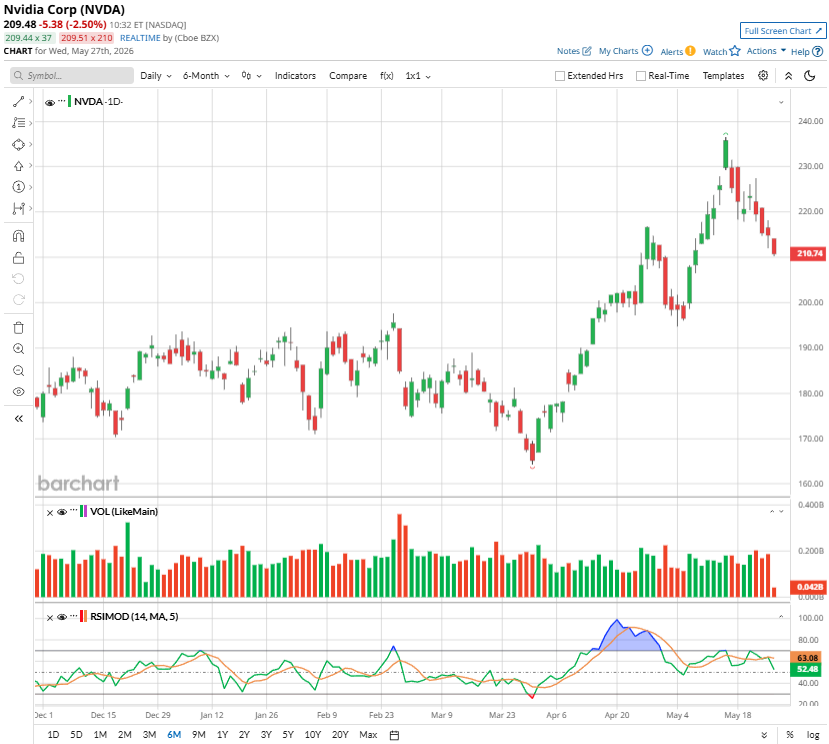
Nvidia reported Q1 revenue of $82 billion, up 85% year over year and 20% sequentially, with data center revenue rising 92% to $75 billion. Management guided Q2 revenue to about $91 billion, reaffirmed $1 trillion in combined Blackwell and Rubin revenue for 2025-2027, and authorized an additional $80 billion share repurchase program. The article argues NVDA remains attractively valued at 26.72x forward earnings versus AMD at 81.29x, supporting a bullish stance.
NVDA is still the cleanest way to express that AI capex is moving from a single-product cycle into a multi-generation platform buildout. The important second-order effect is that a dominant supplier with accelerating share gains can keep pricing power even while headline valuation looks optically high versus the market, because the market is underestimating the durability of customer lock-in and the mix shift toward networking and systems, not just GPUs. The bigger implication for semis is that peers are likely trading on cyclical beta while NVDA is increasingly behaving like a constrained infrastructure monopoly with recurring upgrade demand.
The CPU push matters less as a new revenue line than as a wedge into system-level control. If Vera becomes a standard attach point for hyperscalers, NVDA captures more of the bill of materials and reduces the odds that customers can multi-source around it; that raises switching costs and could pressure merchant CPU vendors, especially those relying on AI adjacency rather than product differentiation. The market may also be missing that a successful CPU entry expands NVDA’s TAM without requiring a new demand cycle, which is why the upside is not just revenue but higher lifetime wallet share per cluster.
Near term, the stock’s main vulnerability is not demand but expectations: after multiple quarters of acceleration, any guide that implies normalization rather than re-acceleration can trigger multiple compression even if fundamentals remain strong. The other risk is supply-chain execution—if shipment timing or networking ramps slip, the market will extrapolate a capex pause from hyperscalers, which would hit the whole AI complex. Over months, the setup remains favorable, but over days the stock is likely to trade more on commentary around supply and new product cadence than on the headline growth rate.
The contrarian take is that the market may be too focused on relative underperformance versus AMD/INTC and not enough on absolute cash generation and buyback support. If NVDA is effectively self-funding a large portion of float reduction while compounding earnings at a high-30s to mid-70s rate over the next two fiscal years, the multiple gap versus peers is probably rational, not cheap; the true debate is whether it deserves a premium re-rating for platform breadth. That argues for being long NVDA versus the rest of semis, but not for assuming the whole group should rerate together.
AI-powered research, real-time alerts, and portfolio analytics for institutional investors.
Request DemoOverall Sentiment
strongly positive
Sentiment Score
0.78
Ticker Sentiment
