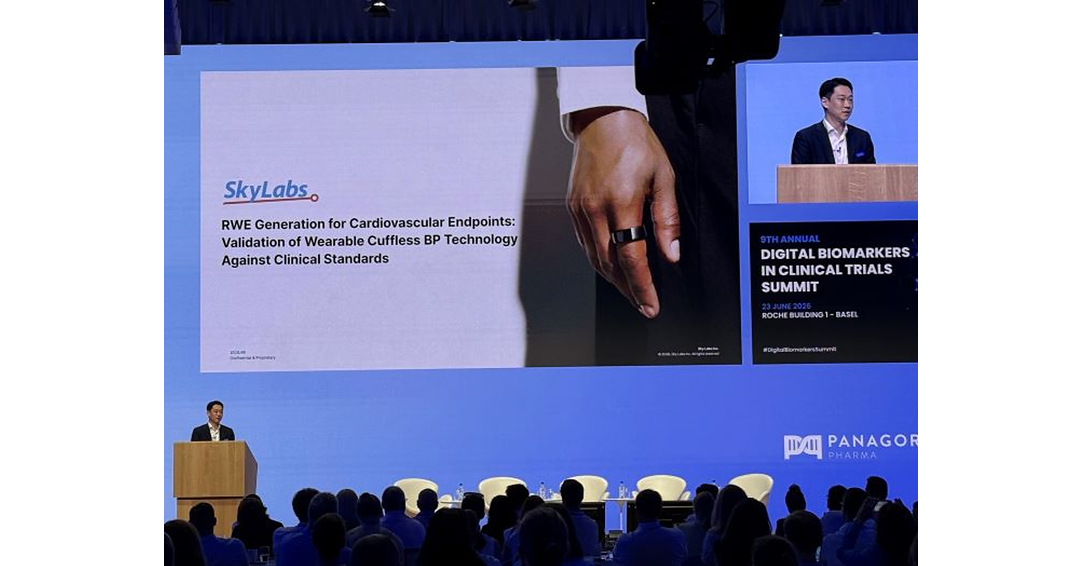
Sky Labs showcased its ring-type cuffless blood pressure monitor, CART BP pro, at the Digital Biomarkers in Clinical Trials Summit to position the platform as a partner for high-quality vital-sign data in drug trials and Real-World Evidence (RWE). The company highlighted that conventional cuff-type ABPM disrupts sleep—citing a 2011 study where 70.2% of users reported sleep disruption and failure to collect adequate 24-hour data rose to 50.0% among low-tolerability participants—while CART BP pro is designed to avoid repeated arm constriction. CART BP pro already has South Korean national health insurance coverage and is officially recommended in revised Korean hypertension guidelines, supporting broader adoption for clinical research and therapeutic response monitoring.
This is more meaningful as a procurement signal than a near-term revenue event. If pharma accepts cuffless vitals as a trial-grade data source, the economic winners are the platforms that can reduce subject dropout, shorten enrollment-to-readout cycles, and lower site monitoring costs; that favors niche data-collection vendors and trial-enablement software more than the large drugmakers in attendance. For NVS and RHHBY, the first-order impact is negligible, but over 12-24 months they could be among the buyers that accelerate standardization if the workflow integrates cleanly into multicenter protocols.
The less obvious loser is the incumbent ambulatory BP device ecosystem: traditional cuff-based monitoring tools may not disappear, but their pricing power weakens if sponsors increasingly specify continuous, lower-burden wearables in protocol design. The second-order effect is on CROs and sites, where better adherence could improve data completeness and reduce repeat measures, compressing trial operating expense. That said, the market should treat this as optionality until there are named pharma pilot programs or a protocol amendment from a regulated sponsor.
The main risk is execution, not technology theater: without reproducible data integrity, validated interoperability, and privacy/security controls, adoption stays confined to pilot studies and domestic reimbursements. In the next 1-3 months, the catalyst is partnership announcements; over 6-18 months, it is whether one or two global pharma programs move from exploratory use to standard endpoint collection. If that does not happen, the current optimism likely fades into another conference-driven wearable story.
AI-powered research, real-time alerts, and portfolio analytics for institutional investors.
Request DemoOverall Sentiment
mildly positive
Sentiment Score
0.18
Ticker Sentiment
