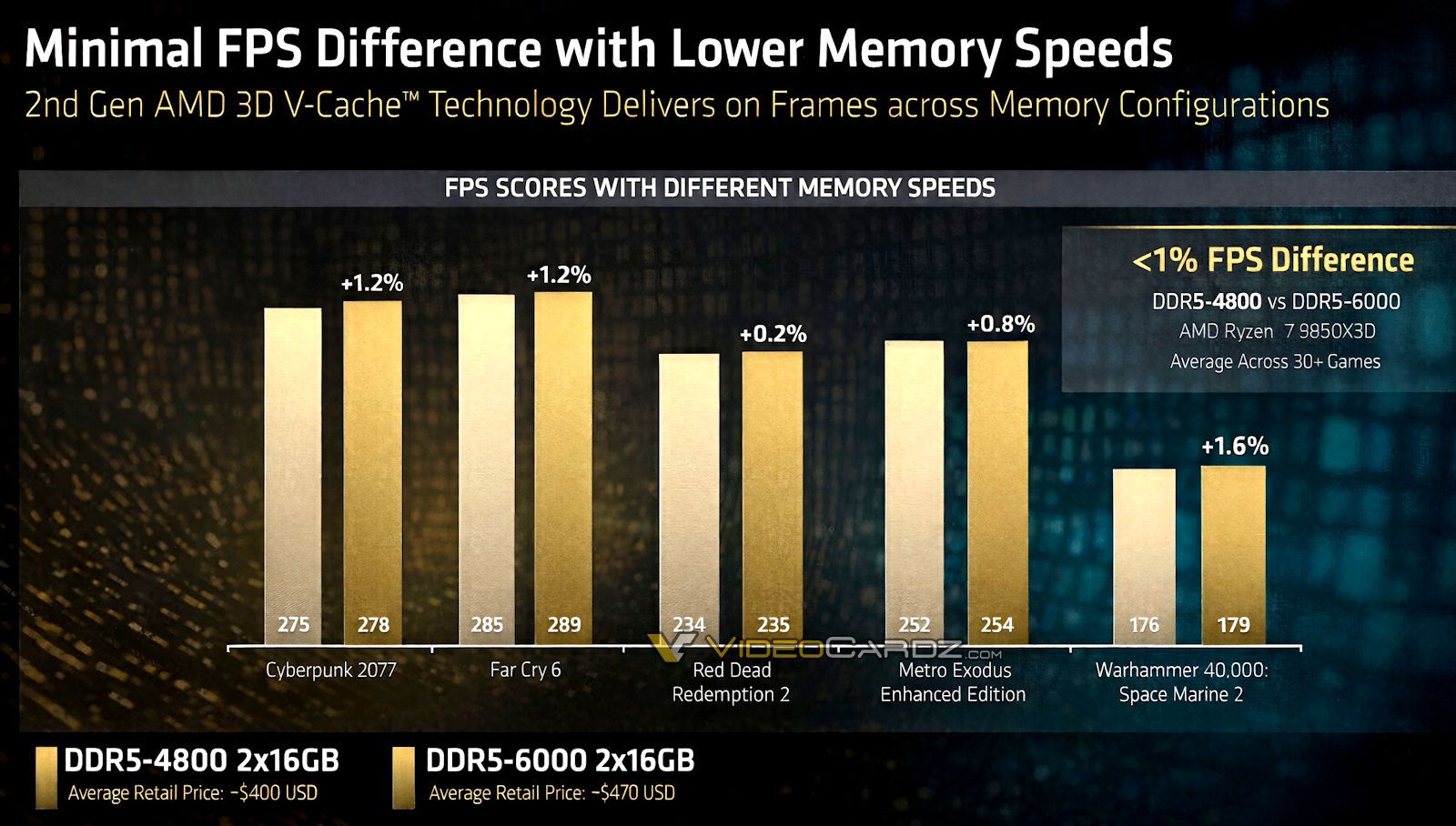
AMD’s Ryzen 7 9850X3D, shown at CES 2026, claims a roughly 7% performance uplift over the Ryzen 7 9800X3D while internal slides indicate under a 1% FPS difference between DDR5-4800 and DDR5-5600 across several games (largest gap 1.6% in Warhammer 40,000: Space Marine 2). AMD cites average 32GB kit prices of $400 for DDR5-4800 and $470 for DDR5-6000 (though retailers show DDR5-6000 as low as $325.99), implying up to ~ $70 potential savings for system builders as X3D’s large on-die L3 cache reduces dependence on premium memory — a consumer-cost advantage likely to influence buying behavior but with limited near-term market-moving impact for AMD.
Market structure: AMD is a direct winner — X3D reducing sensitivity to DDR5 speed lowers the marginal value of high‑speed RAM and shifts consumer buying to CPUs with large on‑die cache; expect modest upside to AMD ASPs and share in DIY/gaming over 6–12 months. Losers are niche premium DDR5 SKUs and retailers pricing a $100+ premium (article cites $400 vs $470; real market shows $325–$355), which could see volumes and aftermarket margins fall 10–30% in the PC gaming segment. Cross‑asset: limited macro impact — small downside pressure on DRAM spot prices and related small/SMID stocks, slight compression in implied vol for AMD around product publicity, negligible bond/FX moves unless rollouts materially change capex for memory makers. Risk assessment: Tail risks include an AMD product delay or benchmark reversal, Intel/Apple counter‑moves restoring RAM sensitivity, or a datacenter AI surge that swamps consumer effects and props DRAM prices — low probability but high impact. Time horizons: immediate (days) for retail SKU price moves and social sentiment, short (weeks–months) for channel inventory adjustments, and medium (2–4 quarters) for material revenue shifts at memory suppliers. Hidden dependencies: OEM adoption, motherboard/BIOS support, and consumer upgrade cycles; key catalysts are AMD shipment guidance, Q2 channel checks on DDR5 pricing, and Micron/Samsung earnings commentary. Trade implications: Tactical long AMD exposure is warranted to play product differentiation — size 1–2% NAV, horizon 6–12 months, target 12–20% upside if share gains materialize; implement via 3–6 month call spread (limit premium) or small outright equity. Trim or avoid pure consumer DRAM plays: if 32GB DDR5‑6000 vs 4800 premium narrows to <$30 for 60 days, reduce exposure to DRAM retail/DIY revenue by 1–3% NAV (consider MU puts sized to risk tolerance). Consider a relative pair: long AMD (1–2%) / short MU (0.5–1%) as a directional play on CPU cache value vs commodity DRAM, with stops at 12% adverse move. Contrarian angle: The market may overestimate consumer DRAM demand share — datacenter AI demand still dominates DRAM fundamentals, so broad shorts on MU/Samsung risk being wrong if AI ramps continue. Historical parallels: past cache innovations (e.g., larger L3) shifted consumer economics but did not collapse DRAM TAM; expect substitution, not elimination. Unintended consequence: if AMD captures share and raises ASPs, motherboard and GPU spending could rise, benefiting AMZN/retailers indirectly — monitor AMD channel ASPs and DRAM kit price spreads as leading indicators.
AI-powered research, real-time alerts, and portfolio analytics for institutional investors.
Request DemoOverall Sentiment
mildly positive
Sentiment Score
0.28
Ticker Sentiment
