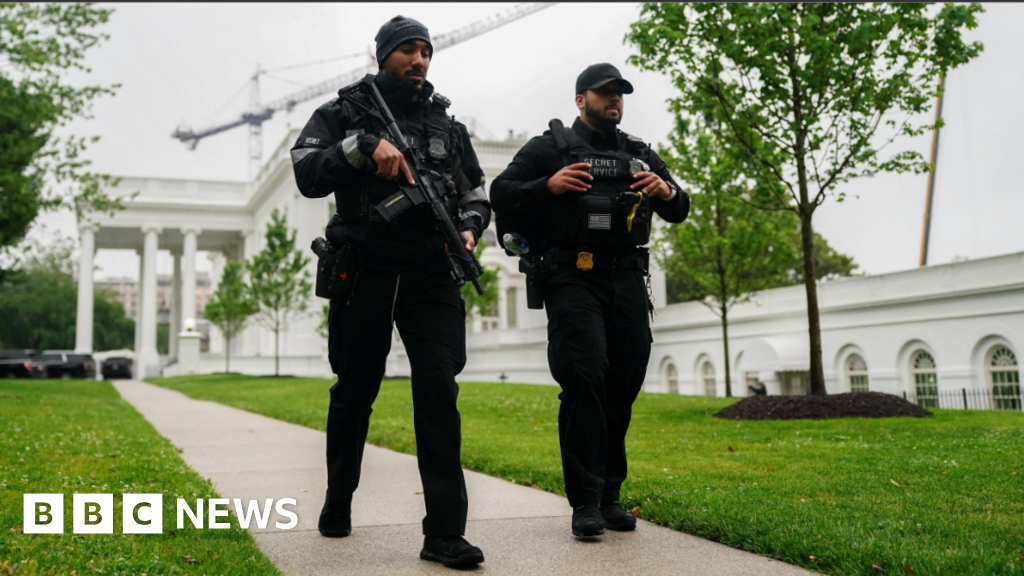
A gunman was shot dead after firing outside the White House, and a bystander was wounded; President Trump was unharmed and no White House operations were impacted. Court documents show the suspect had prior run-ins with the Secret Service, including a June 2025 mental evaluation, a July arrest for unlawful entry, and an outstanding no-bond warrant after failing to appear in August. The event is primarily a domestic security and legal matter with limited direct market impact.
This is not an “event risk” for broad equities so much as a stochastic security premium that should stay elevated into the election cycle. The more important second-order effect is a likely increase in visible federal protection spend: protective details, physical hardening around government sites, and surveillance tech procurement tend to get funded faster after high-profile perimeter failures, even if the political rhetoric initially focuses on law enforcement competence. That favors contractors with exposure to integrated security, access control, sensors, and command-and-control software more than pure-play firearms names, which often face offsetting political backlash.
The other implication is operational: the market should treat this as a tail-risk reminder for downtown DC office users, hospitality, and event venues near federal clusters. Even if the absolute economic impact is small, repeated incidents can raise insurance premiums and suppress discretionary foot traffic for weeks, not days, particularly around government-adjacent districts and large public events. That creates a subtle headwind for local real estate owners with heavier D.C. exposure, especially those with mixed-use assets reliant on convention or tourism traffic.
Consensus may overfocus on the immediate headline and underfocus on the persistence of security spending. In prior cycles, one incident can justify budget line items that last multiple fiscal years because procurement is path-dependent once agencies justify upgrades. The contrarian angle is that the market may temporarily sell the obvious beneficiaries on “no near-term contract visibility,” but the real catalyst is not a single award—it is a rising probability distribution of multi-year modernization spend as agencies respond to repeated perimeter breaches.
The risk to this thesis is reversal if the episode is reframed as an isolated mental-health/crime case rather than a systemic security failure; that would shorten the political half-life to days. But if there are follow-on incidents, or if Congress/HSA hearings become a platform for funding commitments, the trade can compound over months through backlog revisions and higher budget authority expectations.
AI-powered research, real-time alerts, and portfolio analytics for institutional investors.
Request DemoOverall Sentiment
moderately negative
Sentiment Score
-0.35
