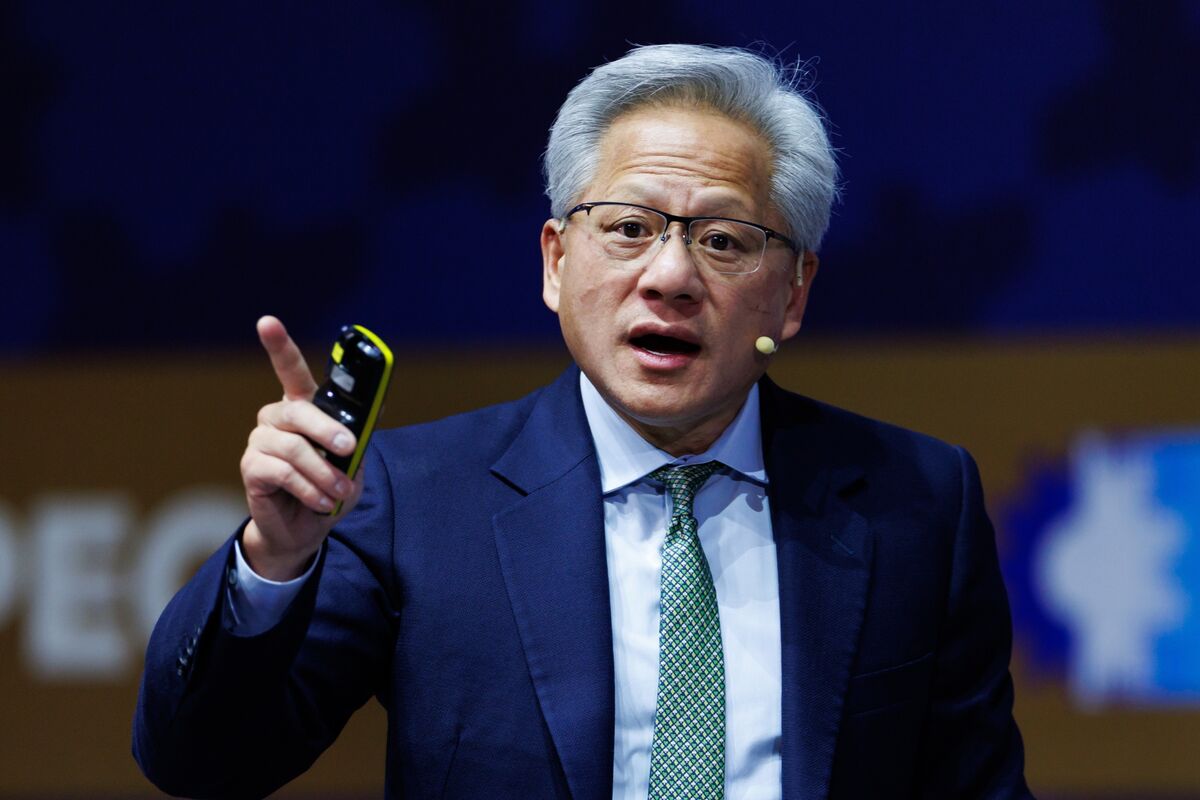
Nvidia’s blistering stock rally pushed the Jen-Hsun and Lori Huang Foundation’s assets up 170% to $9.2 billion in 2024, forcing CEO Jensen Huang to again double philanthropic payouts; the foundation donated more than $126 million last year, according to its latest tax filing. The jump in foundation assets — driven by Nvidia equity gains — raises ongoing philanthropic obligations and highlights how concentrated equity appreciation can affect management-linked foundations and capital allocation decisions.
Market structure: Nvidia’s rally concentrates demand into semiconductors, cloud (AMZN, MSFT, GOOGL) and AI software winners while pressuring legacy CPU/PC segments. The foundation math (assets = $9.2B) implies larger mandated distributions and a potential incremental supply shock into NVDA or related ETFs; even $200–500M of incremental selling over 3–12 months could move near-term liquidity-sensitive spreads and ETFs (SOXX, QQQ). Higher pricing power for NVDA raises bargaining leverage vs. peers (AMD, INTC) and increases capex cadence for suppliers (ASML, LRCX).
Risk assessment: Key tail risks are regulatory/geopolitical export controls to China, abrupt TSMC capacity shortfalls, or a philanthropic-driven concentrated share sale tied to the ~5% private-foundation distribution rule (5% of $9.2B = ~$460M vs $126M already given → ~$334M gap). Near-term (days/weeks) watch for 990-PF disclosures or announced in-kind donations; medium-term (3–12 months) monitor selling cadence and 10-Q lockups; long-term fundamentals remain tied to AI adoption and wafer capacity (12–36 months). Hidden dependency: if donations are made in-kind to charities that liquidate, selling could be staggered and algorithmically executed, amplifying intraday vols.
Trade implications: Direct: maintain a core 1.5–2.5% long NVDA (ticker NVDA) exposure but hedge with 3-month 5–10% OTM put or buy a 3×2 call spread (buy 10% OTM, sell 30% OTM) to limit capital. Relative: long ASML (ASML) or LRCX 1–2% to play capex, pair vs. short QQQ tech beta by 1:1 to isolate semiconductor alpha. Options: sell covered calls on NVDA to collect premium into earnings and buy 6-month put spreads as tails if foundation selling is confirmed. Entry: accumulate on intraday/weekly pullbacks >5% and trim into +25–40% rallies.
Contrarian angles: Consensus underestimates the mechanics of foundation distributions — the 5% rule creates a quantifiable sell target (~$334M incremental) that could transiently depress NVDA but also provide tactical entry points. The market may also overprice perpetual demand; if donations are predominantly in-kind to charities focused on AI research, proceeds may recycle into startups not public equities, reducing supply pressure. Historical parallels: large donor selling (e.g., Gates/Graham transitions) produced short, shallow impacts; still, algorithmic execution patterns could amplify volatility — prepare for >=10% intraday moves.
AI-powered research, real-time alerts, and portfolio analytics for institutional investors.
Request DemoOverall Sentiment
mildly positive
Sentiment Score
0.35
Ticker Sentiment
