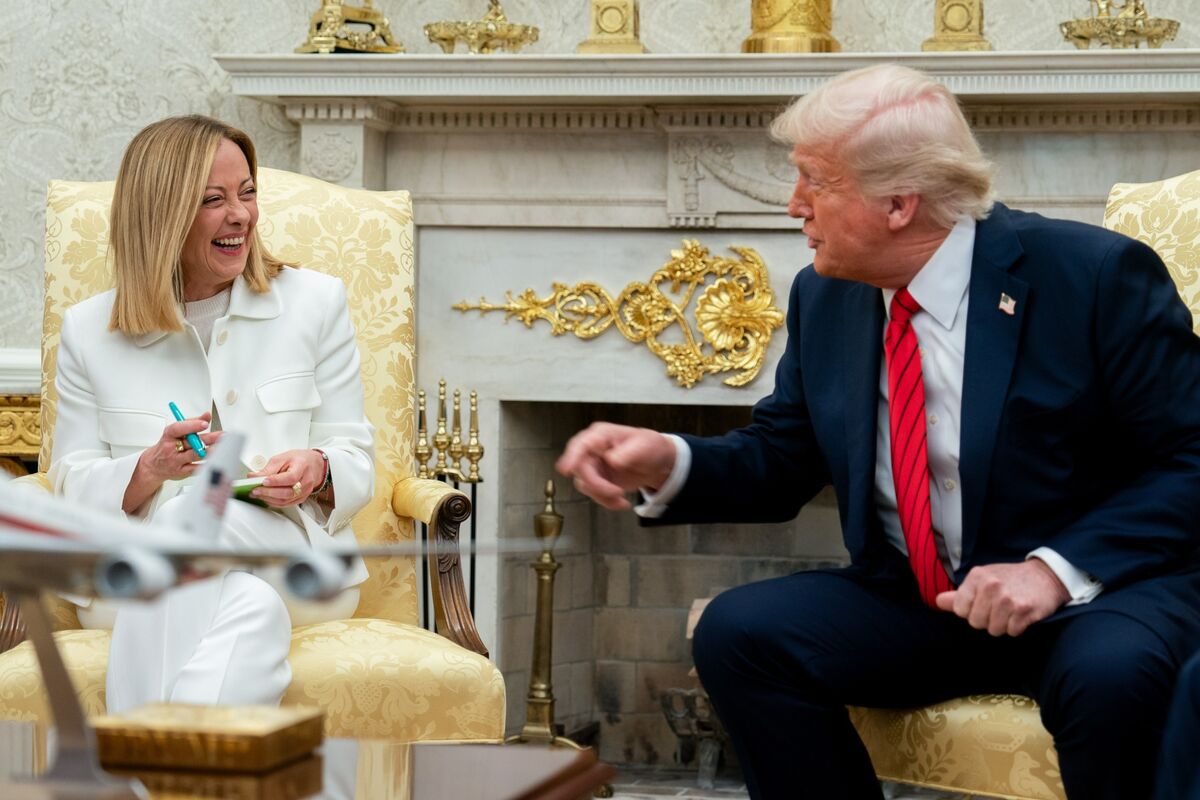
Italian Prime Minister Giorgia Meloni said she has had no recent contact with President Donald Trump, but described US-Italy ties as "solid." The article highlights political friction over Trump’s Iran war stance and Meloni’s defense of Pope Leo XIV, with no direct policy or market-moving announcement.
The market implication is not Italy-specific so much as EU coalition fragility: Washington’s pressure on a high-visibility European leader raises the odds of louder intra-European splits on sanctions, defense spending, and Middle East posture. That tends to help hard-security beneficiaries over broad European beta, while adding a small but real risk premium to Italian sovereigns if domestic opposition frames the episode as a diplomatic slippage rather than a manageable rift.
Second-order, the biggest asset-class effect is on policy optionality. A cooler relationship between Rome and Washington reduces Meloni’s ability to act as a bridge on trade/security files, which can slow consensus formation in Brussels just when transatlantic coordination matters most. In practice, that means more headline volatility for defense, energy, and exporters than for the broad market, with any underperformance likely concentrated in sectors dependent on frictionless US-EU alignment.
The contrarian view is that this may be more theater than regime change: Trump’s foreign-policy style often produces periodic public friction without a durable policy break. If so, any selloff in Italian risk assets or Europe-facing names should be faded unless it is accompanied by concrete evidence of tariff threats, funding delays, or NATO coordination issues over the next 1-3 months. The real tail risk is not the rhetoric itself, but a cascade where domestic political actors in Italy or the US use the spat to harden positions ahead of budget and election cycles.
For positioning, the cleaner trade is relative value rather than outright direction: own European defense exposure against broader Italy-sensitive cyclicals, and treat any spike in Italian risk premiums as a short-lived entry point unless there is follow-through in bond spreads. If the rhetoric escalates further, the next catalyst is not diplomacy but market-access risk—anything that hints at trade retaliation or procurement friction would matter more than the current noise.
AI-powered research, real-time alerts, and portfolio analytics for institutional investors.
Request TrialOverall Sentiment
neutral
Sentiment Score
0.00
