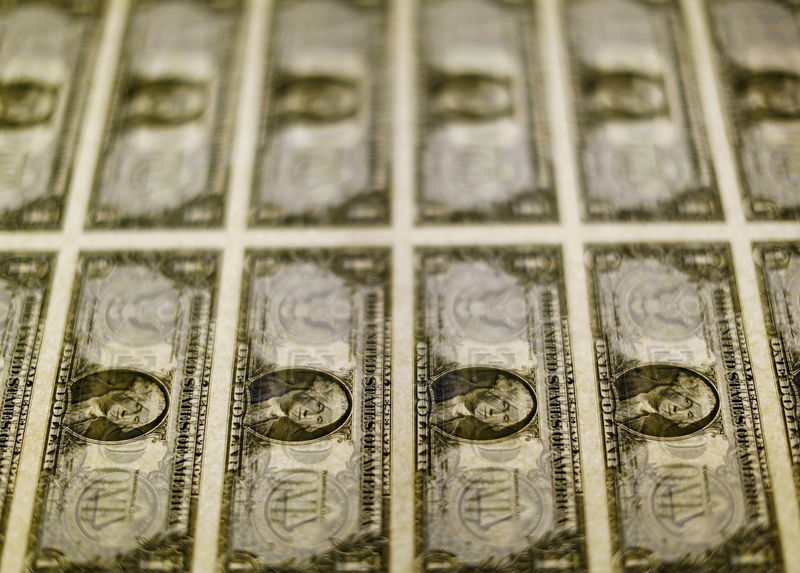
The dollar index rose about 0.1% and stayed near six-week highs as Fed minutes showed more officials open to rate hikes if inflation remains above 2%, reinforcing a hawkish policy tilt. Geopolitical uncertainty around the Iran war added support to the dollar and pressured Asian currencies, while the Australian dollar fell 0.5% after weaker-than-expected jobs data and the Indian rupee hit record lows near 97 per dollar. Japanese trade and PMI data were stronger, but the broader tone was risk-off across FX markets.
The near-term winner is not “the dollar” in the abstract, but U.S. real yields relative to cyclically softer commodity currencies. If the Fed is forced to stay restrictive while energy keeps inflation sticky, the carry advantage shifts back toward USD funding pairs and away from high-beta pro-cyclical currencies; that typically hurts AUD, NZD, and select EM FX before it shows up in U.S. growth data.
The second-order effect is on Asia’s balance-of-payments sensitivity to imported energy. A prolonged oil shock tightens financial conditions fastest in economies with weaker external buffers and higher import dependence, which can create a self-reinforcing loop: FX weakness raises local inflation, which limits easing, which further pressures domestic demand. That setup is more dangerous for India and parts of Southeast Asia than for Japan, where stronger trade data helps the currency marginally but higher import costs still bleed into margins for manufacturers and utilities.
The contrarian take is that the FX move may already be partially crowded if markets are treating every Iran headline as a one-way dollar bid. A genuine de-escalation would matter more for currencies than for rates: it could trigger a sharp unwind in commodity FX and EM hedges even if the Fed remains hawkish, because the inflation impulse would fade faster than the policy reaction. That makes the next 1-3 weeks a headline-driven regime rather than a clean macro trend.
For Nasdaq, the direct read-through is broader risk appetite and duration sensitivity, not index-level sector specifics. Higher rates and geopolitical risk usually compress multiples first; if that persists into the IPO window, primary issuance pricing power deteriorates and secondary tech proxies can underperform even without any company-specific news.
AI-powered research, real-time alerts, and portfolio analytics for institutional investors.
Request DemoOverall Sentiment
mildly negative
Sentiment Score
-0.12
Ticker Sentiment
