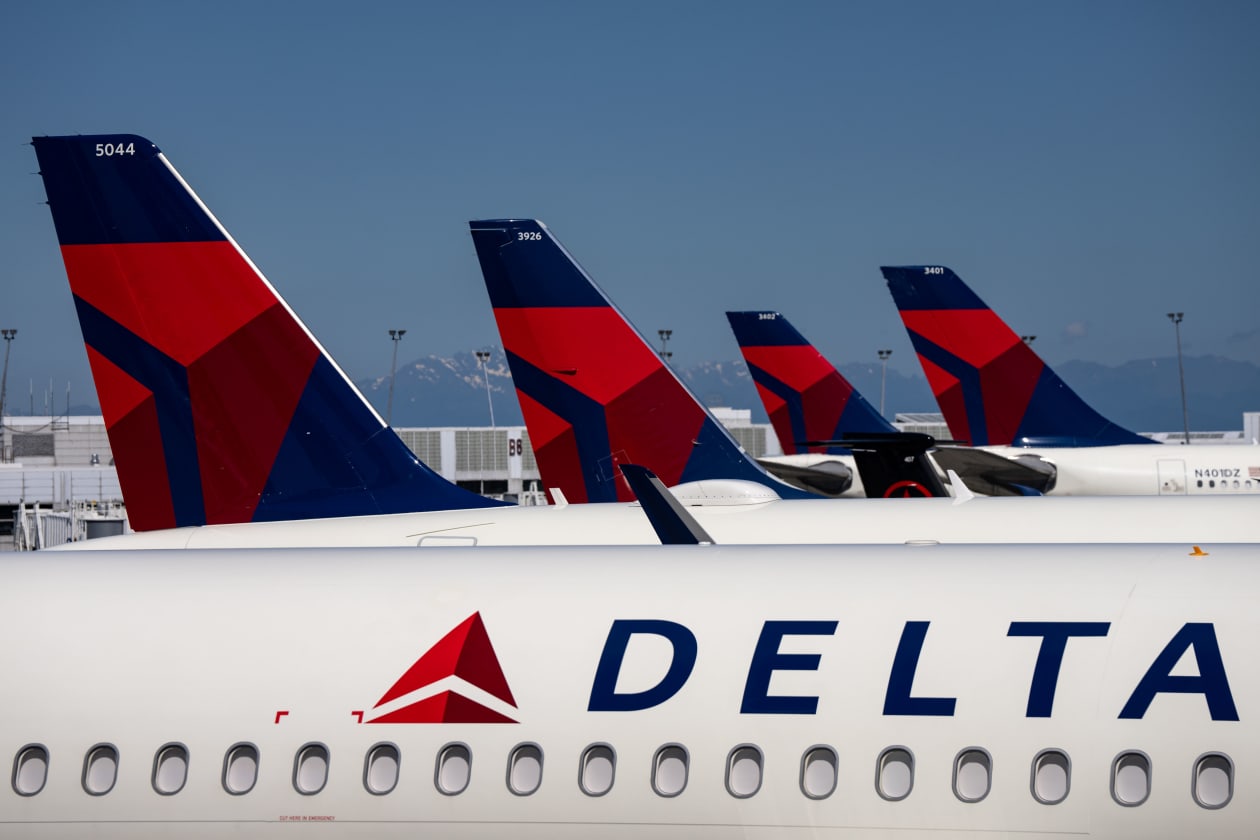
Delta raised its current-quarter revenue outlook despite a surge in oil prices tied to the Iran conflict, saying consumer and corporate travel demand "have accelerated into March." The guidance, delivered at the J.P. Morgan Industrials Conference, came in well above expectations and pushed DAL shares to outpace the S&P 500. Management's message signals confidence that rising fuel costs are unlikely to materially dent near-term revenue.
Delta’s ability to sustain upward revenue momentum while fuel costs spike implies meaningful pricing power and yield resilience in the near term: think 3–6 month elasticity of demand < -0.2 in key corporate lanes, allowing yield gains to outpace unit cost increases by a few hundred basis points if capacity remains disciplined. That advantage flows to carriers with stronger corporate mixes and ancillary revenue (premium seats, cargo), and conversely penalizes pure leisure/LCC models that compete on headline fares where fuel is a larger share of unit cost.
Key tail risks are oil-driven and binary: a sustained jet-fuel move above $100/bbl (or a +$15/bbl delta vs Brent) materially compresses margins within one quarter absent hedges, while a macro slowdown that hits corporate T&E would depress yields with a 2–3 quarter lag. Watch forward booking curves, corporate negotiated-fare rollovers, and jet-fuel crack spreads as near-term triggers — each can flip sentiment inside 30–90 days.
Second-order winners include distribution and data players that monetize advance-booking clarity (OTAs/GDS) and MRO/lessor stocks that benefit from higher utilizations and aircraft retirements underpinning lease rates; airport retail and premium seating ecosystems also gain if demand mix shifts upward. Suppliers exposed to narrowbody maintenance and spares see order visibility improve over 6–18 months as airlines prioritize reliability over unit-cost cuts.
Contrarian flag: the market may be conflating revenue strength with margin improvement — revenue beats are necessary but not sufficient if fuel exposure is unhedged or CASM ex-fuel moves up. The current rally looks vulnerable to a 10–20% mean reversion if a short-term spike in jet fuel or a softening corporate-travel cadence emerges, creating a tactical window for disciplined hedged exposure rather than outright leverage.
AI-powered research, real-time alerts, and portfolio analytics for institutional investors.
Request DemoOverall Sentiment
strongly positive
Sentiment Score
0.60
Ticker Sentiment
