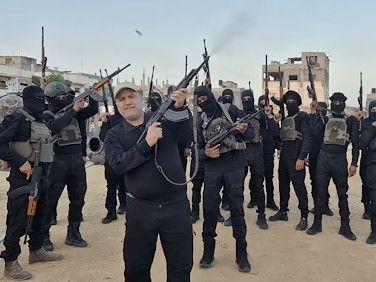
At least five Israel-backed militia factions are operating in eastern Gaza along the so-called 'Yellow Line', conducting attacks on Hamas, receiving weapons, logistics and coordination from the Israeli military, and aiming to secure local governance and reconstruction sites such as Rafah. Israel’s acknowledgment of activating these groups, reports that Israel controls over 50% of Gaza, and rising tit-for-tat violence — including executions and the killing of militia leaders — materially raise regional political and security risk, increasing uncertainty for reconstruction projects, humanitarian access and any related defense or infrastructure contracting opportunities.
Market structure: The activation of Israeli-backed militias increases the probability of a protracted, low-intensity conflict concentrated in Gaza’s east — this favors defense contractors, ISR/surveillance providers, and private security firms (A/D demand up ~5–15% over 3–12 months if conflict persists), while tourism, regional retail and local construction activity suffer near-term cashflow shocks. Pricing power will shift to suppliers of small arms, drones, secure comms and reconstruction contractors, but large-scale reconstruction contracts are likely delayed 6–24 months, compressing near-term revenues for cement/heavy-equip players despite a longer-term demand surge.
Risk assessment: Tail risks include Iran escalation or wider regionalization (low probability ~10–20% in next 6 months but high impact: oil +$20–40/bbl, global equities -8–15%), and a humanitarian blockade that triggers sanctions/aid cut-offs affecting logistics firms. Immediate (days) effect = volatility spike and safe-haven flows; short-term (weeks–months) = defense order/tactical procurement cycles; long-term (quarters–years) = reconstruction contracts and permanent defense budget reallocation. Hidden dependencies: US/European political support cadence, Suez/Red Sea shipping incidents, and Israeli domestic politics which could accelerate or curtail backing for militias.
Trade implications: Favor CVR to defense/ISR exposure (ETF route ITA/XAR or selective LMT, RTX, NOC) and systematic tail hedges (GLD/TLT). Commodities: tactical Brent/WTI long if incidents in Red Sea/Suez occur — expect +2–6% on localized escalation, +20–50% on Iran direct involvement. Short consumer discretionary/airlines with EM/region travel exposure (e.g., UAL/DAL) on 0–3 month horizon as demand softens. Use options to buy skewed protection (3-month 25–30 delta calls on ITA/GLD and 25–30 delta puts on airlines/regionals).
Contrarian angles: Consensus may overprice short-term reconstruction winners — many contracts will be politicized and delayed >12 months, so pure construction longs (CAT, CRH) are premature. Conversely, small-cap ISR/security suppliers and select Israeli defense names may be under-owned; consider selective 6–18 month LEAPs rather than spot equities. Historical parallels (post-2006/2014 Gaza escalations) show short-term risk premia and oil spikes fade unless Iran enters; therefore scale positions with clear escalation triggers (Suez closure, Iranian strikes, US ground involvement).
AI-powered research, real-time alerts, and portfolio analytics for institutional investors.
Request DemoOverall Sentiment
moderately negative
Sentiment Score
-0.60
