
Musk v Altman: Inside the trial that could reshape the AI race
Source: BBC
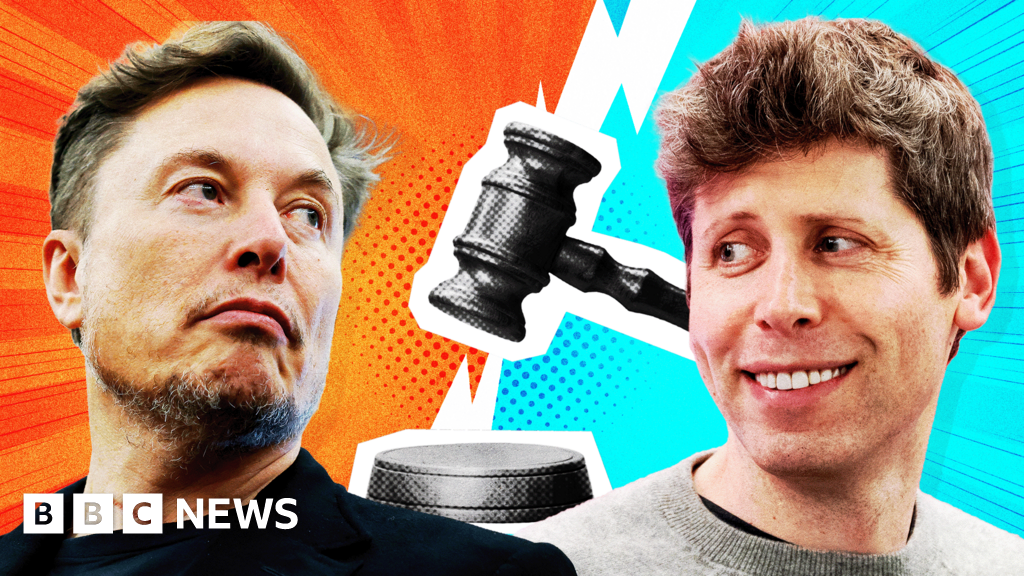
Elon Musk and OpenAI are heading to a month-long federal trial in Oakland over Musk's claims that Altman and OpenAI swindled him out of millions and abandoned OpenAI's nonprofit mission. Musk is seeking billions in alleged wrongful gains, governance changes, and Altman's ouster, while OpenAI argues Musk is motivated by jealousy and competition as both race toward AGI. The case could expose key details on OpenAI's shift to a for-profit model and may matter for the competitive landscape in AI, but it is more likely to affect sentiment than broader markets.
Analysis
The market-relevant issue is not the courtroom theatrics; it is the potential for discovery to surface internal documents that either validate or weaken the governance story around frontier AI monetization. A clean win for OpenAI would reduce legal overhang and reinforce the premium on incumbency, while any credible evidence that the nonprofit structure was compromised could trigger a broader repricing of AI governance risk across private-market comparables, especially late-stage unicorns moving toward IPOs.
MSFT is the most exposed ticker here because the case implicitly tests whether Microsoft’s commercial relationship with OpenAI was a passive customer arrangement or an active participant in alleged mission drift. Even if Microsoft ultimately avoids liability, the more immediate risk is multiple compression if investors start treating AI partnership structures as litigation-prone, which would matter for Azure AI attach-rate narratives over the next 1-2 quarters. META is a secondary beneficiary of any slowing/chaos at OpenAI because it reduces the probability of a dominant external model vendor consolidating mindshare, but the effect is modest versus its own open-model strategy.
The contrarian view is that a protracted trial may actually be bullish for the entire AI ecosystem in the medium term because it forces clearer lines between nonprofit stewardship, cap table economics, and model commercialization. That could lower the discount rate applied to AI investments if the market concludes the structure is becoming more mature rather than more fragile. TSLA is largely a narrative bystander unless the dispute meaningfully distracts Musk or leads to document disclosures that spill into xAI financing or governance, which would be a longer-dated risk than the next few weeks.
AllMind Terminal
AI-powered research, real-time alerts, and portfolio analytics for institutional investors.
Request TrialMarket Sentiment
Overall Sentiment
neutral
Sentiment Score
-0.10
Ticker Sentiment
Key Decisions for Investors
- Short MSFT vs long QQQ for 2-6 weeks into peak trial headlines: target modest multiple compression on AI-related governance overhang; cover if the court narrows liability early or if MSFT guidance explicitly de-risks Azure AI revenue.
- Buy MSFT downside protection via 1-2 month put spreads around event dates: limited premium outlay against gap risk if testimony produces damaging internal emails or settlement chatter.
- Small long META relative to MSFT on a 1-3 month horizon: if OpenAI’s brand is distracted, capital and developer attention can rotate toward open-model alternatives; keep sizing modest because the fundamental linkage is indirect.
- Avoid directional TSLA exposure from this catalyst alone: the trial is more likely to affect Musk attention/credibility than car demand; only consider a TSLA short if xAI financing or governance disclosures broaden materially.
- Watch AI private-market comps for a 2-4 week de-rating: if trial evidence suggests commercialization tainted the nonprofit story, reduce exposure to late-stage AI names priced on OpenAI-style exit multiples.
More News
- The economy has undergone a structural transformation that ended the low-cost era. ‘The regime change in inflation and interest rates is the outcome’
- AI agents are agreeing and acting: machines are now smarter than humans. Their principals merely agree
- Nvidia CEO Jensen Huang emerges as Trump's top ally in AI safety debate
- OpenAI Just Beat Google, Meta, and Amazon To This Key Milestone. Is It Bullish for AI Stocks.
- Top Wall Street analysts find these 3 stocks attractive as long-term investments
- The Caterpillar Correction Shouldn't Last Much Longer