
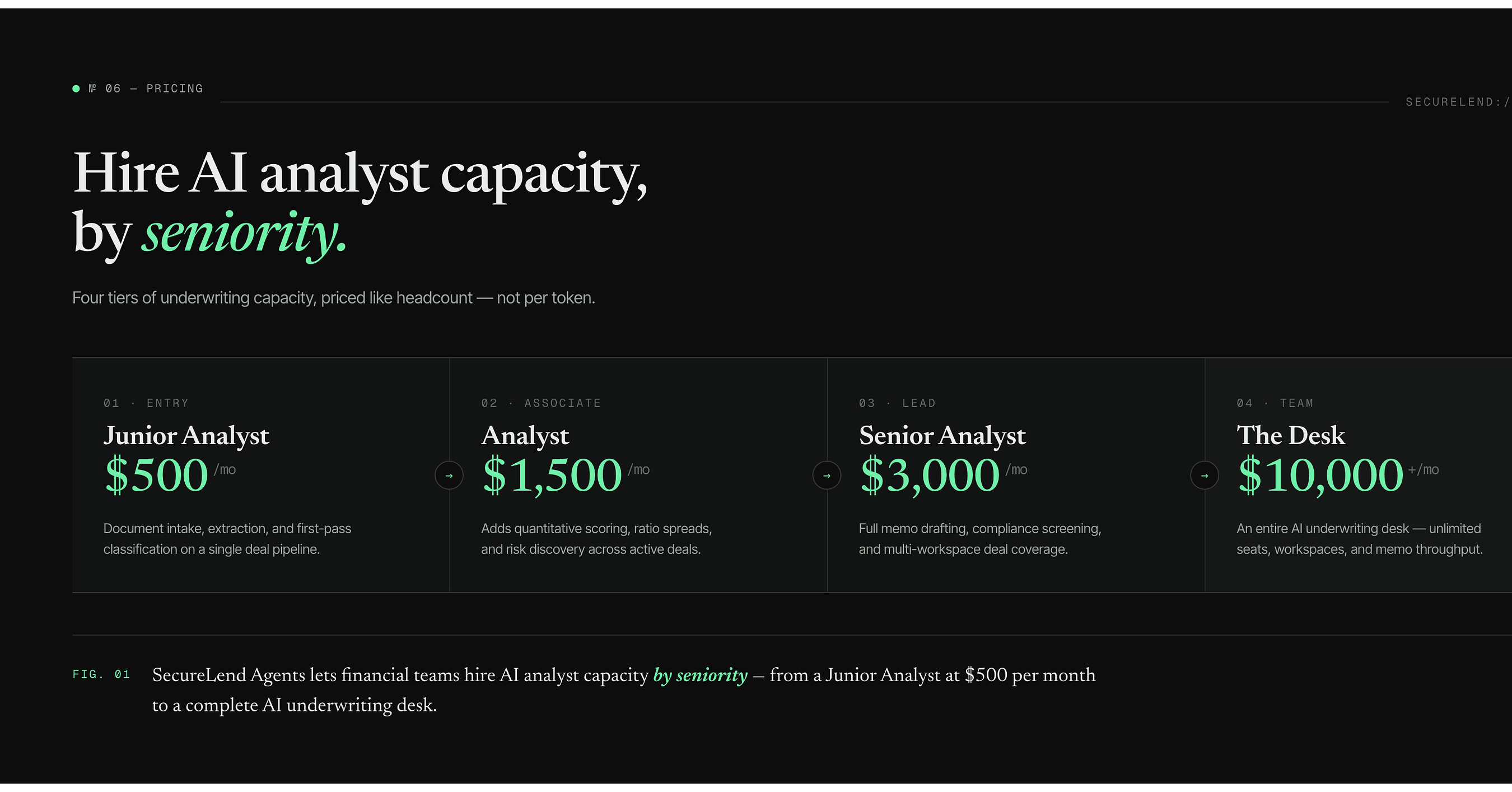
SecureLend launched the general availability of SecureLend Agents, offering AI “financial analysts” for $500/month (vs. a $100,000 analyst), targeting lending/private credit/VC/PE and investment banking workflows. In Q2 2026 pilots it reported up to 99.2% document accuracy, ~75% lower estimated processing costs vs. manual processing, and six-section memo drafts in under three minutes, with SOC 2 Type II controls and human approval gates. The update is mainly product/operational rather than a macro catalyst, so expected market impact is limited.
This is less a pure “AI winner” event than a pricing reset for credit workflow labor. The first-order beneficiary is any platform that can turn underwriting into software gross margin; the second-order winner is the lender, because lower processing cost can either widen spreads or be passed through as faster approvals and better borrower conversion. That matters most in private credit and middle-market origination, where cycle time is a competitive moat and even a modest reduction in analyst labor can raise ROE if credit losses stay contained.
The less obvious losers are human-heavy outsourcing and middle-office service models that sell “analyst capacity” rather than decisioning IP. If this workflow actually works inside lending ops, it pressures services multiples for firms whose economics depend on billable headcount, while accelerating demand for data plumbing, audit trails, and decision engines. That favors infrastructure names with embedded distribution and compliance stickiness over point-solution vendors with weak integration.
The main risk is that the claimed economics are pilot economics, not scaled deployment economics: exception handling, model governance, and workflow integration usually erase a big chunk of headline savings. In the next 1-3 months, watch for conversion from trial to contracted ARR and evidence that the product reduces time-to-decision without increasing loss rates; over 6-18 months, the key test is whether lenders actually expand originations or simply shrink headcount. If underwriting losses or override rates rise, the thesis fails quickly.
AI-powered research, real-time alerts, and portfolio analytics for institutional investors.
Overall Sentiment
mildly positive
Sentiment Score
0.35
Ticker Sentiment
