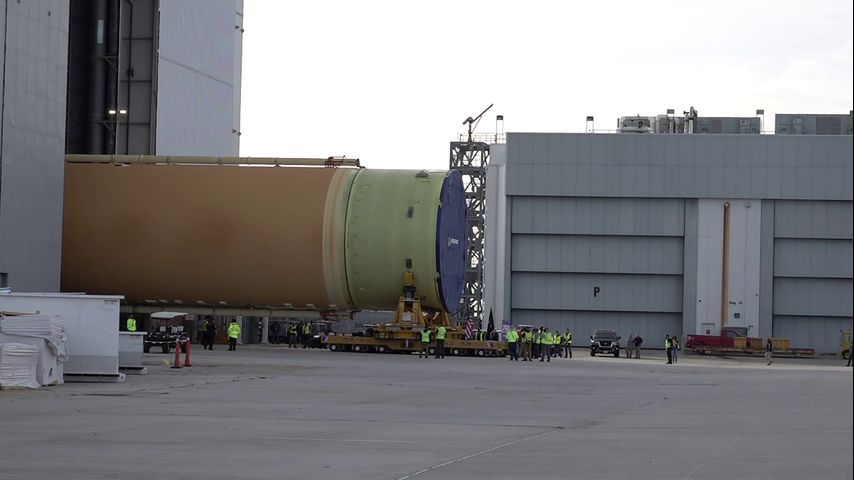
NASA will roll the largest section of the Space Launch System rocket out of Michoud Assembly Facility in New Orleans on Monday for shipment to Kennedy Space Center. The section includes the liquid hydrogen tank, liquid oxygen tank, intertank and forward skirt for Artemis III, which is currently scheduled for launch in 2027. The update is operational and schedule-related, with limited near-term market impact.
This is not a direct revenue event, but it is a validation event for the industrial base behind a politically protected, multi-year aerospace program. The near-term beneficiary set is less the prime contractor alone and more the ecosystem of barge logistics, precision heavy-lift, cryogenic hardware, and qualified fabrication capacity; the market usually underprices the fact that these programs create a multi-year backlog of high-margin, low-cyclicality work once a platform is approved and physically moving through the system.
The second-order read-through is capacity discipline. Programs like this are bottlenecked by specialized tooling, QA, and scarce talent, so every successful transport milestone raises the probability of follow-on funding and makes it harder for newer entrants to displace incumbents. That tends to support margins for companies with already-certified processes while leaving generic industrial peers behind, even if the headline sounds like a one-off government milestone.
The real risk is schedule slippage, not cancellation. For a 2027 target, the tradeable horizon is months to years: any propulsion, test, or integration issue can delay cash conversion and push out working-capital absorption, which matters more for smaller suppliers than for primes. Contrarian angle: the market often treats space headlines as sentiment-only, but if the cadence of milestones continues, the underappreciated winner is logistics and specialty manufacturing, not the moonshot narrative itself.
If the Artemis schedule remains intact, expect incremental positive revisions to backlog visibility across the aerospace supply chain; if delays mount, the pain will show first in niche subcontractors and transport providers rather than the headline program. That creates a cleaner relative-value opportunity than an outright thematic long.
AI-powered research, real-time alerts, and portfolio analytics for institutional investors.
Request TrialOverall Sentiment
neutral
Sentiment Score
0.10
