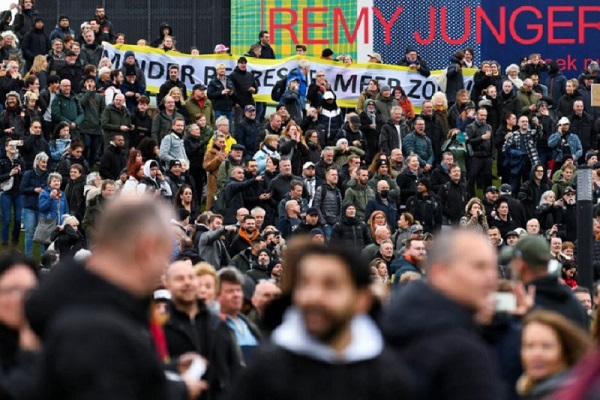
Thousands of protesters in Tirana opposed a Kushner-backed luxury resort project in Albania, the largest demonstration yet against the development. Public backlash is centered on land ownership, protected-area use, environmental concerns and the approval process, while Prime Minister Edi Rama رفض stepping down and defended the project. The dispute adds political and regulatory risk around a large private tourism investment, but appears unlikely to have broad market impact.
This is less about a single resort and more about the re-pricing of political permission risk in frontier EM. When a project tied to a globally polarizing sponsor becomes the flashpoint, the market starts demanding a higher hurdle rate for all coastal/greenfield tourism and real-estate developments in the country, which can slow FDI conversion even if headline GDP optics remain intact. The second-order loser is the broader “Albania as a cheap Mediterranean growth story” trade: once local protests scale, institutional investors will likely widen the spread between signed MOUs and actually bankable projects.
The near-term risk is not construction delay alone, but regulatory spillover. If the government doubles down, you get more protest cadence and a higher probability of permitting review, judicial challenges, or parliamentary scrutiny over land use; if it backtracks, it signals policy fragility and encourages bid-offer widening across future concession assets. Either outcome raises the cost of capital for developers, hospitality operators, and any private-market sponsor underwriting political stability as part of the base case.
For public markets, the cleanest read-through is on regional travel and leisure exposure with Balkan coastal sensitivity, not on Albania alone. Operators with broader Mediterranean exposure should see minimal direct earnings impact, but local-in-country forward bookings, pre-sales, and land banking values can get marked down quickly over the next 1-3 months if protests persist. Longer term, the real beneficiary may be incumbents with existing permits and utilities in place: supply growth gets harder, which supports pricing power for established resorts if the political noise does not metastasize into a broader anti-development wave.
The contrarian view is that this may ultimately be a selection effect, not a terminal hit to Albanian tourism. If the government enforces clearer permitting and environmental guardrails, the country could actually improve project quality and investor discipline, benefiting higher-standard developers over politically connected entrants. That makes this more of a dispersion event than a broad macro short—unless the protests broaden into a governance crisis.
AI-powered research, real-time alerts, and portfolio analytics for institutional investors.
Request DemoOverall Sentiment
mildly negative
Sentiment Score
-0.20
