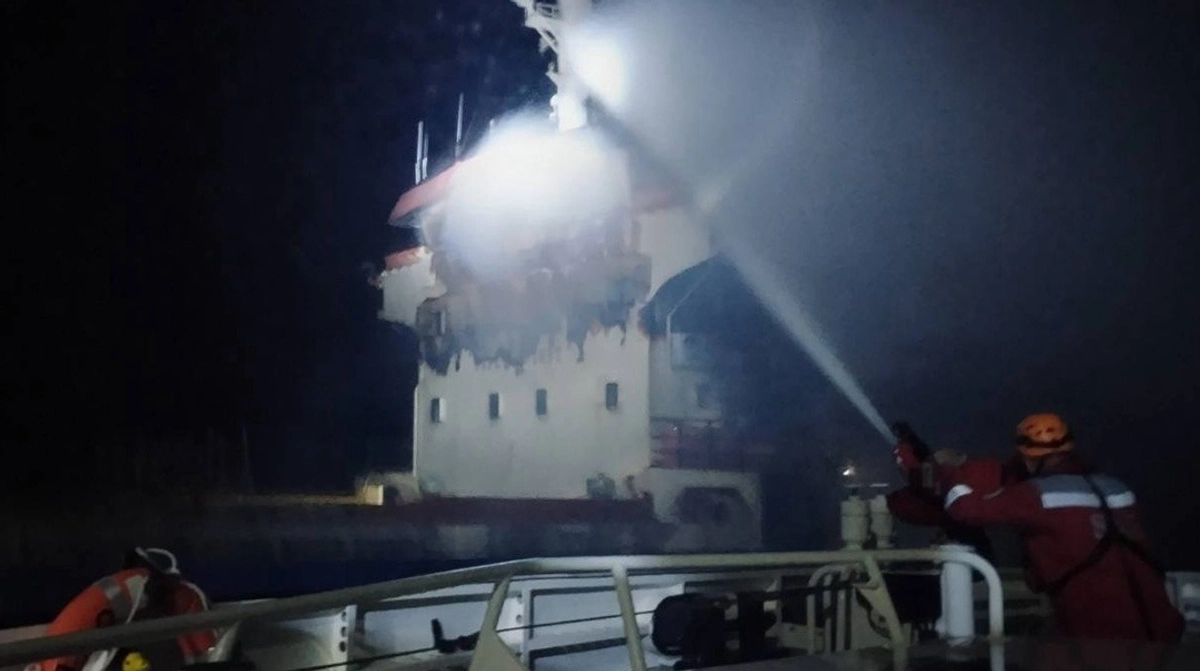
Russian forces struck a Turkish-operated dry cargo vessel near Odesa Oblast, triggering a fire on the ship's superstructure and injuring 2 crew members. The vessel, ANT, was sailing from a port in Odesa Oblast to Türkiye and was carrying cargo under the flag of Vanuatu. The fire was quickly contained and the injured crew were evacuated to hospital.
This is less about the single ship and more about a behavioral shift: the market has to reprice “safe passage” assumptions for Black Sea logistics. Even if physical damage is contained, the economic effect is a higher war-risk premium on every voyage touching southern Ukraine, which should widen insurance, delay charter decisions, and push shippers to bake in more buffers. That tends to hit spot freight and raise working-capital needs before it shows up in headline throughput data.
The second-order winner is any route or asset that can substitute away from the Black Sea corridor. Turkish and Romanian transshipment points, Danube-adjacent logistics, and overland rail/trucking alternatives should see relative volume support if this persists for weeks rather than days. The loser set is broader than maritime operators: grain exporters, commodity merchandisers, and industrials with just-in-time inventory dependence on the region all face margin pressure from higher disruption costs and delivery uncertainty.
The key catalyst is whether this becomes isolated noise or a repeatable pattern. If attacks on commercial traffic continue over the next 2-6 weeks, expect a nonlinear response: insurers re-underwrite, commodity buyers diversify sourcing, and freight rates on substitute lanes stay elevated even after the next ceasefire rumor. If there is no follow-through, the market will likely fade the event within days, because the physical damage itself is not yet large enough to justify a lasting rerating.
Contrarian view: the move may be underpriced if investors treat it as a geopolitical headline rather than a logistics constraint. The real risk is not the vessel loss, but the cumulative effect on scheduling reliability and cargo rerouting, which can persist longer than front-page attention. That makes the trade asymmetric: small immediate operational damage, but potentially meaningful medium-term revenue transfer to alternative corridors and defense-adjacent infrastructure.
AI-powered research, real-time alerts, and portfolio analytics for institutional investors.
Request TrialOverall Sentiment
strongly negative
Sentiment Score
-0.72
