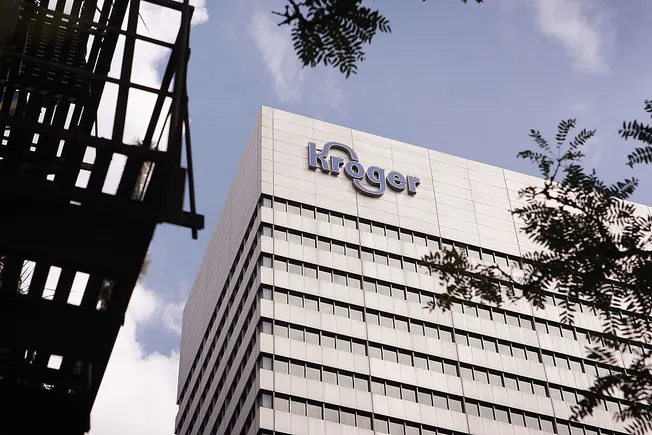
Kroger announced the retirement of Valerie Jabbar, its senior vice president of retail divisions, marking at least the third executive departure since Greg Foran became CEO in February. Jabbar spent her entire career at Kroger, rising from a clerk in 1987 to senior leadership roles before being appointed SVP in 2021. The article is mostly a personnel update with limited immediate financial impact.
This looks less like routine succession and more like a broad operating reset under a new CEO. In grocery, management turnover often creates a short-term productivity dip because store execution, labor scheduling, and vendor negotiation are heavily relationship-driven; the risk is not headline churn but subtle slippage in in-stock rates, shrink control, and local assortment discipline over the next 1-2 quarters.
The second-order effect is that institutional knowledge walks out the door faster than it is replaced, which can widen the gap versus operators with more stable field leadership. That matters most in a low-margin, high-frequency business where a 10-20 bps move in gross margin or a modest degradation in labor efficiency can swing consensus earnings. Competitors with sharper execution or more centralized decision-making can pick off share in fragmented regions before Kroger’s new org structure settles.
The market is likely to underprice the timing mismatch between leadership change and operational proof. If the transition is about upgrading accountability, that can be bullish over 12+ months; but in the near term, investors should care about whether store-level comps, inventory turns, and pharmacy/center-store productivity show any wobble. The reversal signal would be stable same-store traffic with improving shrink and labor metrics by the next two earnings prints.
Contrarian angle: this may be a healthy cleanup rather than a governance red flag. If the new regime is deliberately pushing out legacy operators to flatten the org and improve execution transparency, the stock could recover once the market sees fewer layers and better capital allocation. In that case, the selloff risk is more about noise than fundamentals, but the burden of proof shifts to management quickly.
AI-powered research, real-time alerts, and portfolio analytics for institutional investors.
Request DemoOverall Sentiment
neutral
Sentiment Score
-0.05
Ticker Sentiment
