
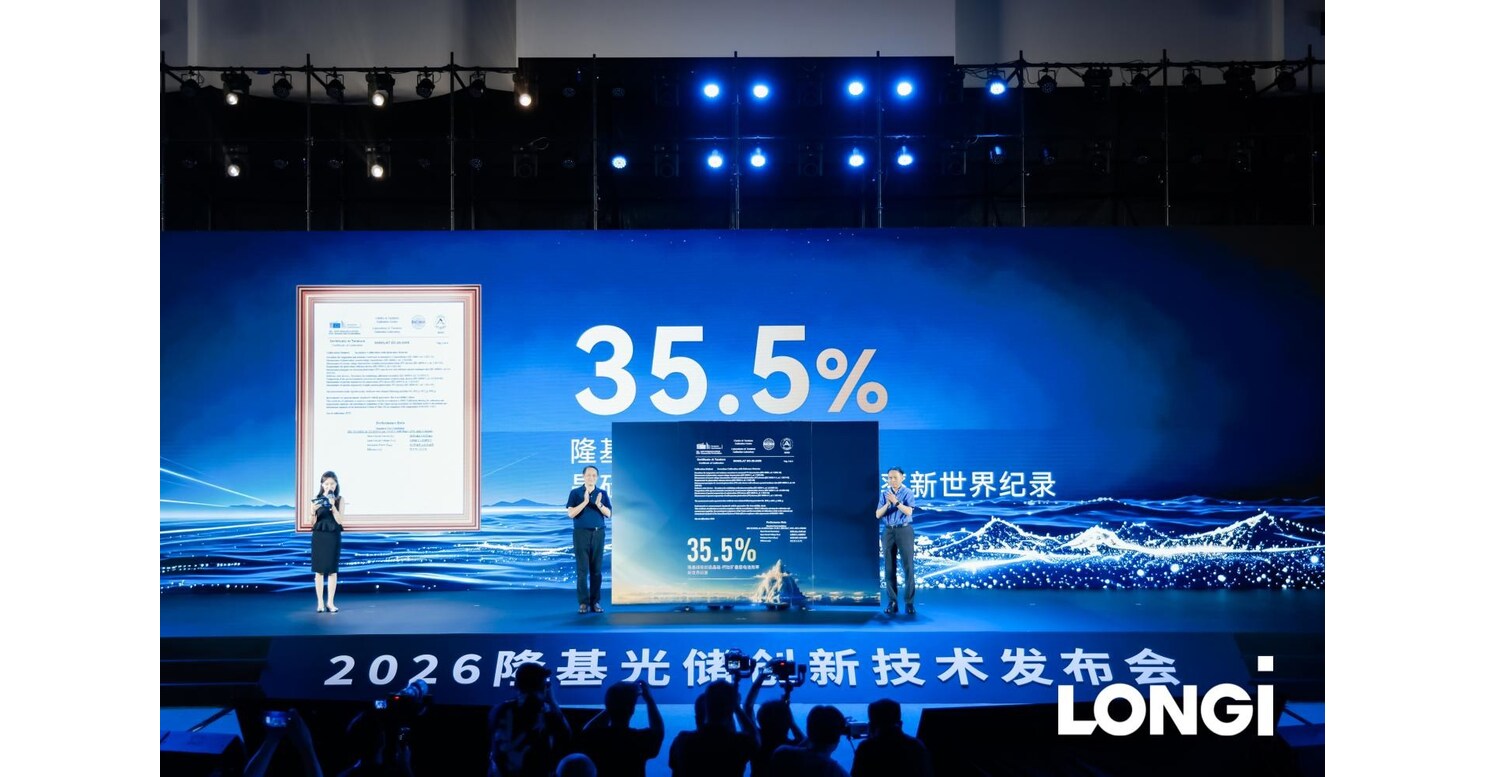
LONGi announced a certified world-record conversion efficiency of 35.5% for independently developed crystalline silicon–perovskite tandem solar cells (certified by ESTI), moving up from 34.6% in June 2024 and 34.85%–35.2% in between. Under larger-area conditions it reported 34.3% (261 cm²) and 32.2% (274 cm²), while tandem modules reached 31.4% and 29.4%, supporting industrialization prospects. The update signals strong technological progress for next-gen ultra-high-efficiency solar, though the article provides no immediate financial figures.
This is a technology-validation event, not a near-term earnings event. The market should care only if tandem efficiency starts to clear the bankability hurdle: stable output, manufacturable yield, and acceptable degradation. Until then, the equity read-through is mostly to sentiment and to which suppliers can monetize a future capex cycle, not to this quarter’s revenue.
If the technology does scale, the first real winners are the firms with process control, deposition, encapsulation, and metrology exposure, plus developers facing land or roof-area constraints. The losers are the low-differentiation module makers whose pricing power depends on a narrow efficiency gap; higher-efficiency modules can compress system-level cost and shift bargaining power away from commodity assemblers. That said, the biggest second-order effect is usually a rerating of the entire solar basket for a few weeks, followed by dispersion once investors realize lab records do not equal P&L.
The contrarian point is timing: the consensus often overweights the headline and underweights durability. What would falsify the bullish thesis is a lack of independent module-scale performance, no disclosure of pilot-line yields, or any sign that degradation/warranty economics make the stack unfinanceable. For CETY and GRYG specifically, I see no direct fundamental read-through unless they can prove a tandem-related product or supply-chain linkage; otherwise this is not a high-conviction trade.
AI-powered research, real-time alerts, and portfolio analytics for institutional investors.
Overall Sentiment
strongly positive
Sentiment Score
0.45
Ticker Sentiment
