
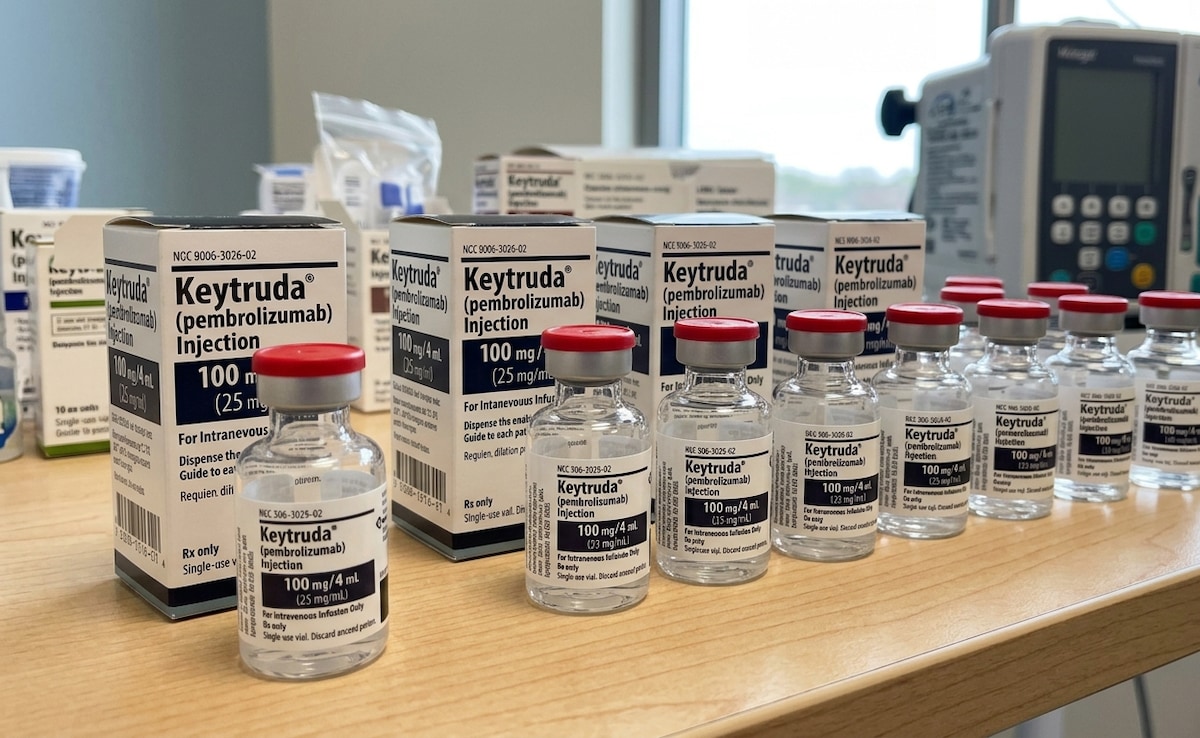
Keytruda (pembrolizumab) is highlighted as a widely used immunotherapy with 14 approved indications across eight tumour types in India, including lung, melanoma, head and neck, gastric, and triple-negative breast cancer. The article emphasizes its biomarker-driven use (PD-L1, MSI-H/dMMR, TMB) and its mechanism as a PD-1 checkpoint inhibitor that reactivates T-cells against cancer cells. The piece is largely educational and supportive of Keytruda's clinical profile, with limited immediate market-moving impact.
MRK’s Keytruda franchise remains the kind of asset that can keep compounding even without a true “new drug” headline, because the economic moat is less about molecule novelty and more about embedded clinical habit, biomarker expansion, and label creep into earlier lines of therapy. The market often underestimates how much of the value is driven by treatment sequencing: once an oncologist is comfortable using a checkpoint inhibitor as a backbone, the franchise benefits across multiple tumor boards, not just one indication. That supports a durable revenue runway and lowers the probability of a sharp demand air pocket unless a new standard-of-care displaces the entire class.
The second-order read-through is to the broader checkpoint-inhibitor ecosystem: this is bullish for companion diagnostics, tumor-genomics testing, and oncology-center utilization, but not equally bullish for peers. A single dominant incumbent tends to compress room for late entrants unless they can show superior toxicity, convenience, or combination efficacy; that raises the bar for other PD-1/L1 developers and makes differentiation in combo regimens more important than simple non-inferiority. The biggest competitive risk is not another me-too asset, but a regimen that reduces infusion burden or shifts treatment earlier enough to make today’s sequencing less attractive.
Key risks are mostly policy and patent/time-horizon related. In the next 3-12 months, the main catalysts are label expansions, combo readouts, and reimbursement friction in ex-U.S. markets; over 2-4 years, the real threat is LOE expectations and whether incremental pipeline assets can offset eventual biosimilar pressure. The article’s “safe drug” framing is directionally supportive, but that also creates consensus complacency: oncology investors may already be assuming low churn, when the actual vulnerability is rising payer scrutiny around high-cost immunotherapy duration and real-world value.
The contrarian view is that the upside is not from the current narrative of safety or breadth — that is mostly priced — but from persistent underappreciation of how long the franchise can remain the default backbone in combination therapy. If more tumors migrate into biomarker-selected earlier-stage use, the total addressable treated population expands even if per-patient duration comes under pressure. That makes MRK more of a durable cash-flow compounder than a high-beta biotech event stock.
AI-powered research, real-time alerts, and portfolio analytics for institutional investors.
Request TrialOverall Sentiment
moderately positive
Sentiment Score
0.45
Ticker Sentiment
