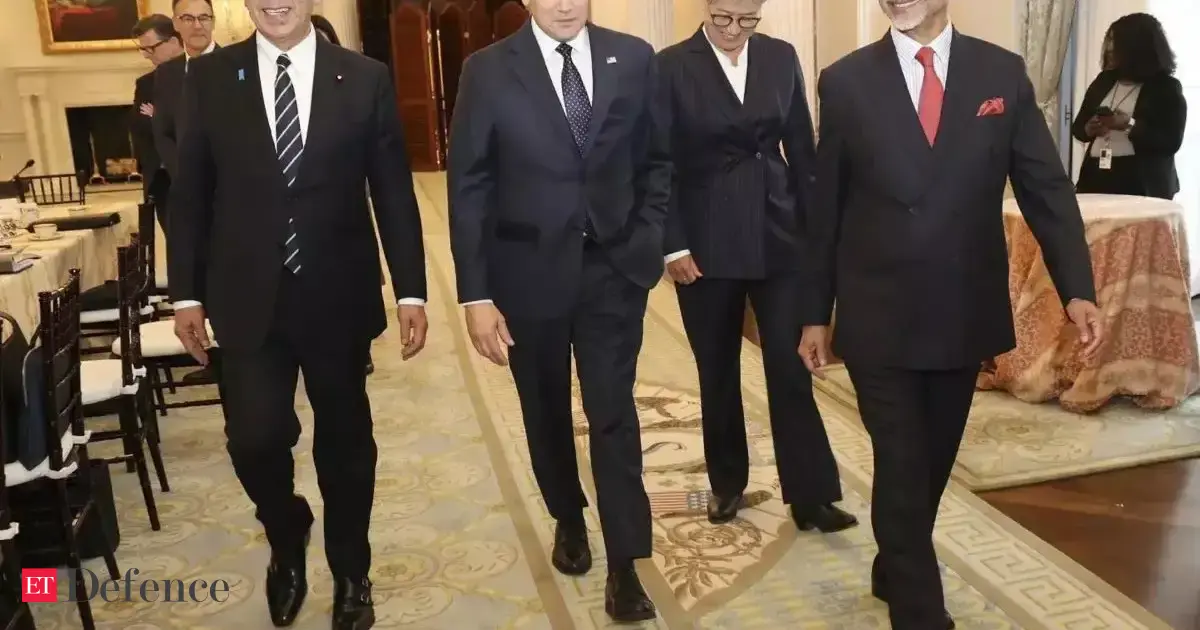
India will host Quad foreign ministers on May 26, with the U.S., Japan and Australia attending as part of ongoing coordination on Indo-Pacific security. The meeting reinforces the alliance’s counterweight to China, but the article describes a diplomatic gathering rather than a policy announcement or market-moving event. Differences remain among members on Russia-Ukraine and Iran, keeping the tone cooperative but limited in immediate market impact.
This is less about an immediate policy breakthrough and more about signaling that the anti-China maritime coalition is still intact despite inconsistent member priorities. The key second-order effect is procurement continuity: repeated Quad choreography tends to favor interoperable systems, ISR, maritime domain awareness, anti-submarine warfare, and secure communications over headline-grabbing platforms. That is a durable medium-term tailwind for defense electronics, naval integration, and dual-use industrials tied to Indo-Pacific resilience rather than pure tank-and-missile exposure.
The market’s consensus is likely underweight the supply-chain angle. A more coordinated Quad creates incremental pressure to diversify away from China-centric critical minerals, electronics assembly, and port infrastructure; beneficiaries are likely to be Indian, Japanese, Australian, and allied vendors that can substitute into logistics, ship repair, sensors, and energy-security buildout. The loser set is narrower but real: Chinese port/logistics ecosystems, select EM transshipment hubs that depend on Chinese throughput, and any regional corporates with high China dependency and low strategic redundancy.
Catalyst risk is asymmetric: the next 1-3 months may be mostly rhetoric, but the real market impact would come if the meeting is followed by concrete working groups on maritime surveillance, export controls, or joint procurement. A downside reversal would require visible divergence on Russia/Iran or domestic political pushback in any member state, which would reduce follow-through and keep the event from becoming a capex cycle. In contrast, any escalation in South China Sea or Indian Ocean incidents would instantly convert this from a diplomacy story into a defense-budget story.
Contrarian view: the move may be undervalued because investors still treat Quad headlines as static geopolitics, when the more important consequence is a slow re-routing of capital expenditure and trade finance over 12-36 months. The trade is not to chase broad EM beta; it is to own enablers of de-risking and maritime persistence where policy alignment can translate into backlog and recurring software/service revenue.
AI-powered research, real-time alerts, and portfolio analytics for institutional investors.
Request DemoOverall Sentiment
neutral
Sentiment Score
0.05
