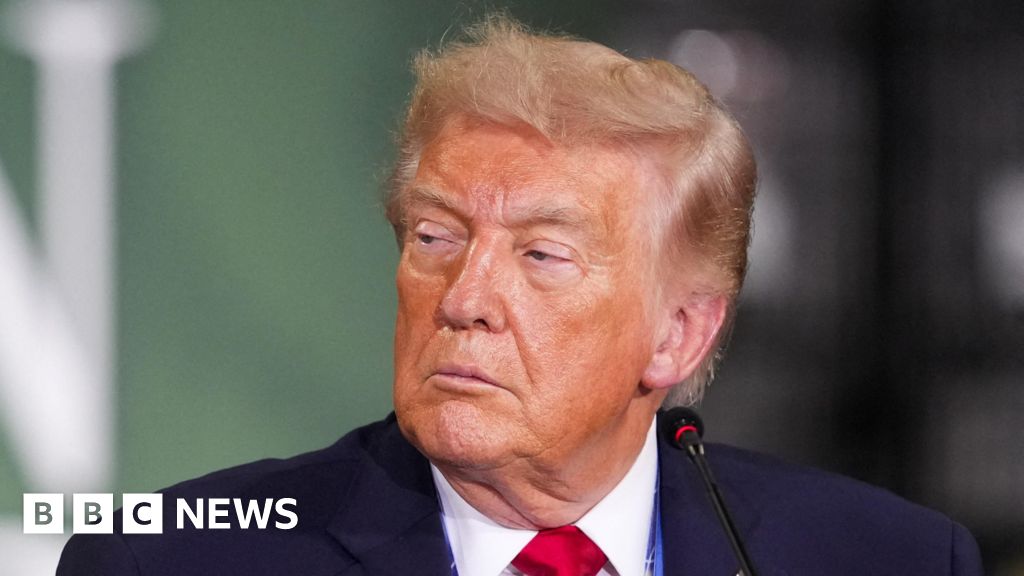
President Trump abruptly ended an NBC interview after repeated challenges on his claims that the California primary and 2020 election were "rigged," escalating his dispute with the media. The interview also covered Iran policy and a now-dropped $1.8bn "anti-weaponisation" compensation fund, but the piece contains no direct market-moving policy announcement. Overall impact is limited, though it reinforces political and media tensions.
This is less about the interview itself and more about the marketability of institutional friction as a recurring political asset. A president leaning harder into anti-media, anti-election-integrity rhetoric raises the probability of policy noise around federal funding, regulatory enforcement, and election-adjacent oversight over the next 3-6 months, which tends to widen the discount rate applied to domestic cyclicals with public-sector exposure. The immediate beneficiaries are less the obvious “news” names and more attention-economy platforms, legal-services intermediaries, and election-admin vendors that gain from prolonged controversy and process complexity.
The first-order market impact is probably modest, but the second-order effect is a higher volatility regime in Washington-sensitive sectors. That matters for defense and energy because geopolitical signaling can be used to offset domestic narrative risk; if the administration wants to pivot, Iran escalation rhetoric can re-price defense primes and oil services faster than equity benchmarks. Conversely, any calming move on Iran would deflate the most crowded geopolitical hedge trades, so these positions are vulnerable to a single headline reversal.
The contrarian read is that the confrontation is not automatically bearish for the president’s agenda; it can strengthen base mobilization and reduce the odds of near-term legislative compromise, which is usually positive for incumbency-style trading in tariffs, defense, and deregulation optionality. The bigger mistake would be to short media/communications broadly on the assumption that trust erosion hurts all publishers equally: polarization can increase engagement and ad yield for select outlets even as it hurts linear TV brands. The best expression is to trade volatility and dispersion, not directionally bet on “media down.”
AI-powered research, real-time alerts, and portfolio analytics for institutional investors.
Request DemoOverall Sentiment
neutral
Sentiment Score
-0.05
